Smart Grid Technology: Future of Energy
Introduction to Smart Grid Technology
Why Traditional Power Grids Are No Longer Enough
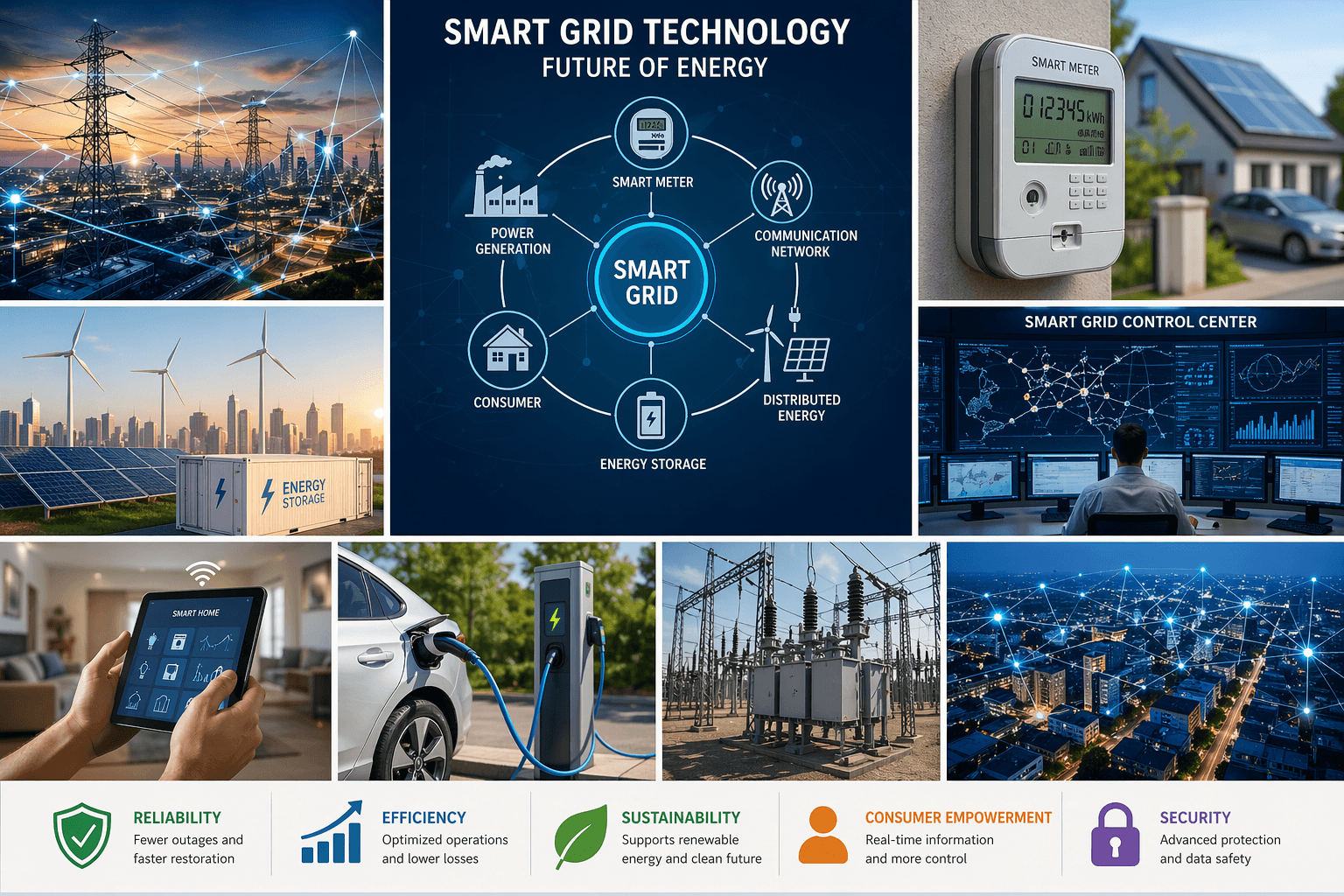
The world’s electricity demand is growing faster than ever, and the old-fashioned power grid is struggling to keep up. Traditional grids were designed decades ago when electricity simply moved in one direction—from power plants to homes and industries. Back then, the system worked like a one-way road. Today, that road has become a crowded highway filled with solar panels, electric vehicles, wind farms, battery storage systems, and smart homes. The old grid was never built for this level of complexity.
Power outages, voltage fluctuations, transmission losses, and poor fault detection are common issues in conventional systems. Utilities often discover problems only after customers complain. That’s like finding out your car engine failed only after smoke starts coming out. Not very efficient, right? The need for a faster, smarter, and more flexible system has pushed the world toward smart grid technology, where electricity and information move together.
Governments and private companies are investing heavily in grid modernization because energy security is now directly linked to economic growth and climate goals. According to recent market reports, the global smart grid market is projected to grow from nearly USD 74.7 billion in 2026 to over USD 245.6 billion by 2034, showing how urgent this transformation has become. This is not just an upgrade—it is a complete redesign of how power systems operate.
The Rise of Digital Energy Infrastructure
Think of a smart grid as the “internet of electricity.” Just as smartphones transformed communication, smart grids are transforming energy systems. Instead of blindly sending power across the network, utilities can now monitor usage, detect faults instantly, predict failures, and optimize supply in real time. This shift makes the power system intelligent rather than reactive.
Digital infrastructure plays a huge role here. Sensors, communication networks, automation devices, and data analytics tools continuously collect and process information. Utilities can know exactly where energy is being wasted, where demand is rising, and where maintenance is needed. This improves both technical performance and customer satisfaction.
Renewable energy integration is another reason smart grids are rising fast. Solar and wind energy are naturally variable—sometimes the sun shines, sometimes it doesn’t. Smart grids help balance this uncertainty by using forecasting tools, storage systems, and demand response programs. Without smart grids, large-scale renewable adoption becomes much harder.
As energy systems become cleaner, more decentralized, and more digital, smart grids are no longer optional. They are becoming the backbone of modern civilization.
What Is Smart Grid Technology?
Core Definition and Working Principle
┌──────────────────────┐
│ Power Generation
│ (Solar/Wind/Thermal)
└─────────┬────────────┘
│
▼
┌──────────────────────┐
│ Transmission System
│ High Voltage Lines
└─────────┬────────────┘
│
▼
┌──────────────────────┐
│ Smart Substation
│ Sensors + Automation
└─────────┬────────────┘
│
▼
┌──────────────────────┐
│ Distribution Network
│ Smart Control System
└─────────┬────────────┘
│
▼
┌──────────────────────┐
│ Smart Meter (AMI)
│ Real-Time Monitoring
└─────────┬────────────┘
│
▼
┌──────────────────────┐
│ Consumer Side
│ Homes/Industry/EVs
└─────────┬────────────┘
│
▼
┌──────────────────────┐
│ Two-Way Communication
│ Utility ↔ Consumer
└──────────────────────┘
Smart grid technology refers to an advanced electricity network that uses digital communication, automation, sensors, and control systems to improve the generation, transmission, distribution, and consumption of electricity. Unlike the traditional grid, it supports two-way communication between utilities and consumers, making the entire system more responsive and efficient.
Imagine your electricity system behaving like a smart assistant. It knows when demand is high, where faults are happening, and how to balance supply automatically. That is the core idea behind a smart grid. It continuously monitors conditions and makes decisions based on real-time data. This reduces wastage, prevents blackouts, and improves energy reliability.
At the heart of this system are technologies like Advanced Metering Infrastructure (AMI), Supervisory Control and Data Acquisition (SCADA), Internet of Things (IoT), Artificial Intelligence (AI), and cloud-based analytics. These tools work together like the nervous system of the grid, sending information instantly across the network.
For example, if a transformer begins overheating, sensors detect it immediately. The system can isolate the fault, alert engineers, and even reroute electricity automatically before a major failure occurs. That level of intelligence changes everything in power system management.
Difference Between Conventional Grid and Smart Grid
The easiest way to understand the difference is to compare a regular bicycle with a self-driving electric car. Both move people, but one is basic while the other is intelligent, adaptive, and connected.
| Feature | Conventional Grid | Smart Grid |
|---|---|---|
| Communication | One-way | Two-way |
| Monitoring | Manual and delayed | Real-time |
| Fault Detection | Slow | Instant |
| Renewable Integration | Limited | High |
| Consumer Participation | Minimal | Active |
| Energy Efficiency | Lower | Higher |
Traditional grids mainly focus on delivering electricity. Smart grids focus on managing electricity intelligently. Consumers are no longer passive users; they become active participants. With smart meters, users can monitor their own consumption, shift usage to cheaper hours, and even sell solar-generated electricity back to the grid.
That’s why smart grids are often described as the future of energy rather than just a technical improvement.
Major Components of a Smart Grid
Smart Meters and Advanced Metering Infrastructure
One of the most visible parts of smart grid technology is the smart meter. Unlike traditional meters that simply record monthly consumption, smart meters provide real-time electricity usage data. They communicate automatically with utilities and allow both sides to monitor energy flow continuously.
This system is called Advanced Metering Infrastructure (AMI). It includes smart meters, communication networks, and data management systems. AMI removes the need for manual meter reading and reduces billing errors significantly. It also helps utilities detect theft, identify outages quickly, and improve customer service.
For consumers, smart meters are like having a fitness tracker for electricity. You can see when your home consumes the most power and adjust habits accordingly. Running heavy appliances during off-peak hours can lower bills and reduce stress on the grid.
Countries around the world are expanding smart meter deployment rapidly because it forms the foundation of digital energy management. Without accurate real-time data, smart grids cannot function effectively.
Sensors, Automation, and Control Systems
Sensors are the eyes and ears of the smart grid. They monitor voltage, current, temperature, frequency, and equipment health across the network. This information helps utilities maintain stability and prevent failures before they escalate.
Automation systems use this data to make fast operational decisions. For example, if a fault occurs on one feeder line, automation can isolate the problem and restore service through an alternative path within seconds. In older systems, this might take hours and require manual field inspection.
Control systems like SCADA and Distribution Management Systems (DMS) act as the brain of the operation. They process incoming data and coordinate actions across substations and distribution networks. This improves reliability and reduces downtime.
It’s similar to air traffic control at an airport. Without coordination, everything becomes chaotic. With intelligent control, movement becomes safe, smooth, and efficient.
Energy Storage and Distributed Energy Resources
Smart grids also depend heavily on Distributed Energy Resources (DERs) like rooftop solar panels, wind turbines, battery storage, and electric vehicles. These resources generate or store electricity closer to where it is used, reducing transmission losses and increasing resilience.
Battery energy storage systems are especially important because renewable sources are intermittent. Solar power disappears at night, but energy demand continues. Batteries help store excess energy and release it when needed, acting like a savings account for electricity.
Electric vehicles are becoming mobile energy assets too. In advanced systems, EVs can even send power back to the grid during peak demand through Vehicle-to-Grid (V2G) technology.
This decentralized model changes the power sector dramatically. Instead of relying only on giant power plants, energy can now come from millions of smaller sources working together intelligently.
Role of AI, IoT, and Big Data in Smart Grids
Real-Time Monitoring and Predictive Maintenance
Artificial Intelligence is turning smart grids from automated systems into learning systems. AI studies patterns in energy demand, equipment behavior, and weather conditions to make better operational decisions. Instead of reacting to failures, utilities can predict them before they happen.
IoT devices provide the raw data needed for this intelligence. Thousands of connected sensors across transformers, substations, and customer endpoints continuously report performance. This creates a living digital map of the grid.
Predictive maintenance is one of the biggest benefits. Rather than replacing equipment on fixed schedules, utilities can service assets exactly when needed. This saves money and prevents unexpected breakdowns. If a transformer shows unusual temperature patterns, AI can flag it weeks before failure.
This approach improves reliability and extends equipment life. It also reduces maintenance costs significantly, which is critical for large utilities managing thousands of assets.
Demand Response and Load Balancing
Electricity demand changes every hour. Morning usage, evening peaks, industrial cycles, and weather conditions all create fluctuations. Smart grids use AI and analytics to manage this dynamic environment through demand response and load balancing.
Demand response means encouraging consumers to reduce or shift electricity use during peak periods. For example, industries may delay non-critical processes, or households may run appliances later at night when electricity is cheaper.
Load balancing ensures supply matches demand without overloading the system. This becomes even more important with renewable energy sources. If cloud cover suddenly reduces solar generation, the grid must respond instantly.
AI helps make these decisions faster and more accurately than humans alone. It turns electricity management into something closer to real-time financial trading—constant, fast, and highly optimized.
Benefits of Smart Grid Technology
Reliability, Efficiency, and Sustainability
The biggest promise of smart grids is simple: better electricity for everyone. Reliability improves because faults are detected and corrected faster. Efficiency improves because power losses are reduced and demand is managed intelligently. Sustainability improves because renewable energy becomes easier to integrate.
Transmission and distribution losses are a major issue in many countries. Smart monitoring helps identify where energy is being wasted and allows targeted improvements. This means more electricity reaches consumers without building more power plants.
Environmental benefits are equally important. Smart grids support clean energy transitions by enabling solar, wind, and storage systems to work smoothly together. They also reduce reliance on fossil-fuel backup systems.
As energy expert Amory Lovins once said, “The cheapest energy is the energy you don’t need to use.” Smart grids help make that philosophy practical.
Consumer Empowerment and Cost Savings
Smart grids don’t just help utilities—they give power back to consumers, literally and financially. With real-time pricing and smart meters, users can control how and when they use electricity. This creates opportunities for lower bills and smarter decisions.
A household with rooftop solar can monitor production, optimize usage, and even sell extra electricity to the grid. Businesses can reduce peak demand charges by shifting operations strategically.
Consumers also benefit from faster outage restoration, better billing transparency, and improved service quality. The relationship between utility and customer becomes more interactive and less frustrating.
Instead of being passive bill-payers, consumers become energy managers. That psychological shift is one of the most powerful outcomes of smart grid adoption.
Challenges and Risks in Smart Grid Implementation
Cybersecurity and Data Privacy Concerns
Every smart system brings a smart risk. Because smart grids rely heavily on digital communication, they are vulnerable to cyberattacks. A successful attack on critical energy infrastructure could disrupt power supply, damage equipment, and create national security threats.
This is why smart grid security is becoming a major industry itself. Reports show the global smart grid security market is projected to grow from USD 9.55 billion in 2026 to USD 23.51 billion by 2034. Utilities must invest in encryption, secure communication protocols, and continuous monitoring.
Data privacy is another concern. Smart meters collect detailed usage patterns that can reveal personal behavior. Strong regulations are needed to ensure customer information is protected.
Technology without trust cannot succeed. Cybersecurity must be treated as a core design feature, not an afterthought.
High Initial Investment and Infrastructure Barriers
Smart grids save money in the long run, but the upfront cost is significant. Replacing meters, upgrading substations, building communication networks, and training staff require major investment.
Developing countries often face additional barriers such as aging infrastructure, policy delays, and limited technical expertise. Utilities may hesitate because returns are not immediate.
Interoperability is another issue. New technologies must work with older legacy systems, which is often more difficult than expected. It’s like trying to connect a modern smartphone to a machine built in 1980.
Strong government policy, regulatory support, and public-private partnerships are essential for overcoming these barriers.
Global Market Trends and Future Scope
Latest Market Statistics and Growth Forecast
The numbers show that smart grid technology is no longer a niche sector—it is a global priority. Market research indicates the global smart grid market is expected to rise from USD 73.8 billion in 2024 to USD 161.1 billion by 2029, growing at a CAGR of 16.9%. Other forecasts suggest even stronger long-term expansion beyond 2035.
North America currently leads adoption due to strong infrastructure investment and renewable integration. Europe follows closely with aggressive carbon neutrality goals. Asia-Pacific is emerging rapidly because of urbanization, industrial growth, and government-backed modernization programs.
The rise of AI data centers, electric mobility, and decentralized energy systems will push demand even further. Smart grids are becoming essential not just for sustainability but for economic competitiveness.
This market growth reflects a simple truth: the future economy runs on intelligent electricity.
Smart Grid Development in India
India is one of the most important smart grid growth markets in the world. Rising electricity demand, renewable energy targets, and urban expansion make modernization unavoidable. Government programs such as the Revamped Distribution Sector Scheme (RDSS) and smart metering initiatives are accelerating progress.
Cities are adopting smart substations, automated distribution systems, and digital billing platforms. Solar rooftop programs and EV charging infrastructure are also driving grid transformation.
Challenges remain—especially in rural connectivity, technical losses, and funding—but the direction is clear. India’s future energy security depends heavily on grid intelligence.
For a country balancing growth, affordability, and sustainability, smart grids are not a luxury. They are a national necessity.
Conclusion
Smart grid technology is reshaping the entire energy ecosystem. It transforms electricity from a simple supply service into an intelligent, responsive, and sustainable network. By combining automation, AI, IoT, renewable integration, and consumer participation, smart grids solve problems that traditional systems can no longer handle.
The journey is not easy. Cybersecurity risks, infrastructure costs, and regulatory complexity are real challenges. But the long-term benefits—better reliability, lower losses, cleaner energy, and empowered consumers—far outweigh the obstacles.
The world is moving toward electrification at an unprecedented pace. Electric vehicles, smart cities, renewable energy, and digital industries all depend on stronger grids. In that future, smart grid technology will not just support development—it will define it.
There are 5 Frequently Asked Questions
1. What is the main purpose of smart grid technology?
The main purpose is to improve electricity generation, transmission, distribution, and consumption using digital monitoring and automation for better efficiency, reliability, and sustainability.
2. How is a smart grid different from a traditional grid?
A traditional grid mainly supports one-way power flow, while a smart grid supports two-way communication, real-time monitoring, fault detection, and renewable energy integration.
3. Why are smart meters important in smart grids?
Smart meters provide real-time energy usage data, improve billing accuracy, support demand response programs, and help consumers manage electricity consumption effectively.
4. What role does AI play in smart grid systems?
AI helps with predictive maintenance, load forecasting, outage prevention, demand response, and efficient grid balancing by analyzing large volumes of real-time operational data.
5. Is smart grid technology important for India?
Yes, it is extremely important because India needs reliable, efficient, and renewable-friendly electricity systems to support economic growth, urbanization, and sustainability goals.

Leave a Reply