How Power Grids Work: From Generation to Your Home
Electricity powers our modern world — from lighting homes and running industries to charging smartphones and driving electric vehicles. But have you ever wondered how electricity travels from a power plant to your home safely and reliably?
In this article, we’ll walk through the complete journey of electrical power — from generation to transmission, distribution, and finally into your household appliances.
1️⃣ Power Generation: Where It All Begins

Electricity is produced at power plants using different energy sources. The main types include:
Thermal Power Plants – Burn coal, natural gas, or oil to produce steam that spins turbines.
Hydroelectric Power Plants – Use flowing water to rotate turbines.
Wind Farms – Use wind turbines to generate power.
Solar Power Plants – Convert sunlight directly into electricity using photovoltaic panels.
Nuclear Power Plants – Use nuclear reactions to generate heat and drive turbines.
No matter the source, most large-scale power plants generate electricity using the same principle:
Mechanical energy → Turbine rotation → Generator → Electrical energy
Electric generators work on electromagnetic induction, producing alternating current (AC).
2️⃣ Step-Up Transformers: Increasing Voltage for Efficiency

Electricity generated at power plants is typically between 11 kV and 25 kV. However, transmitting electricity over long distances at low voltage would cause major energy losses.
Power loss in transmission lines follows:
P=I2R
Where:
P = Power loss
I = Current
R = Resistance
👉 Increasing voltage reduces current for the same power, which dramatically reduces losses.
3️⃣ High-Voltage Transmission: The Power Highways
That’s why step-up transformers raise voltage to extremely high levels (132 kV, 220 kV, 400 kV or even higher) before transmission.
Once stepped up, electricity travels through high-voltage transmission lines supported by tall towers.
These lines:
Carry bulk power over long distances
Connect generating stations to substations
Form part of the national grid
Allow power sharing between states and regions
Modern power grids are interconnected systems that balance supply and demand in real time to maintain stable frequency (typically 50 Hz in many countries).
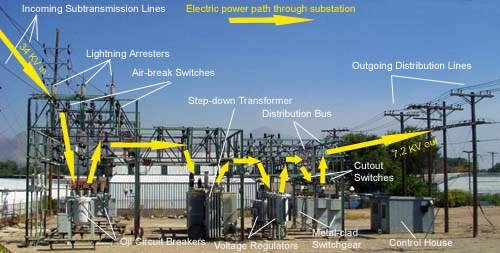
4️⃣ Substations: Voltage Reduction & Control
Before electricity reaches cities and towns, it passes through substations.
Substations perform key functions:
Step down voltage from transmission level (e.g., 220 kV → 33 kV)
Switch and protect power lines
Control and monitor grid performance
Isolate faults to prevent blackouts
Protection systems, circuit breakers, and relays ensure safe and reliable operation.
5️⃣ Distribution Network: Bringing Power to Neighborhoods

From substations, electricity enters the distribution network.
Typical steps:
33 kV → 11 kV (local distribution lines)
11 kV → 415/230 V (near your home using distribution transformers)
In most homes:
230 V is supplied for single-phase loads
415 V is used for three-phase supply (industries & large buildings)
This final voltage level is safe and suitable for household appliances.
6️⃣ Inside Your Home: Final Delivery
 Once electricity reaches your home, it passes through:
Energy Meter – Measures electricity consumption
Main Distribution Board (DB) – Contains circuit breakers
Wiring System – Distributes power to sockets and appliances
Circuit breakers protect your home from overloads and short circuits.
Understanding Basic Electrical Flow
Electric power in AC systems is calculated using:
P=VIP = V I
Where:
P = Power (Watts)
V = Voltage
I = Current
This relationship explains why high voltage and low current are used in transmission — to minimize losses while delivering the same power.
How the Grid Maintains Stability
Power grids must constantly balance generation and demand.
If demand suddenly increases:
Generators increase output
Frequency must stay stable (around 50 Hz)
If imbalance occurs:
Voltage fluctuations
Frequency drops
Possible blackouts
Smart monitoring systems
Automatic generation control (AGC)
Renewable energy integration
Energy storage systems
The Future of Power Grids
Power systems are evolving rapidly with:
Smart Grids
Solar rooftop integration
Electric vehicles
Battery storage
Decentralized microgrids
These innovations are making electricity cleaner, more reliable, and more efficient.
Final Thoughts
From massive power plants to the switch in your room, electricity travels through an incredibly sophisticated network of generators, transformers, transmission lines, substations, and distribution systems.
The next time you turn on a light, remember — it’s the result of a beautifully engineered system working seamlessly behind the scenes.
Leave a Reply