Top Geography Topics for all exams
Physical Geography & Natural Hazards
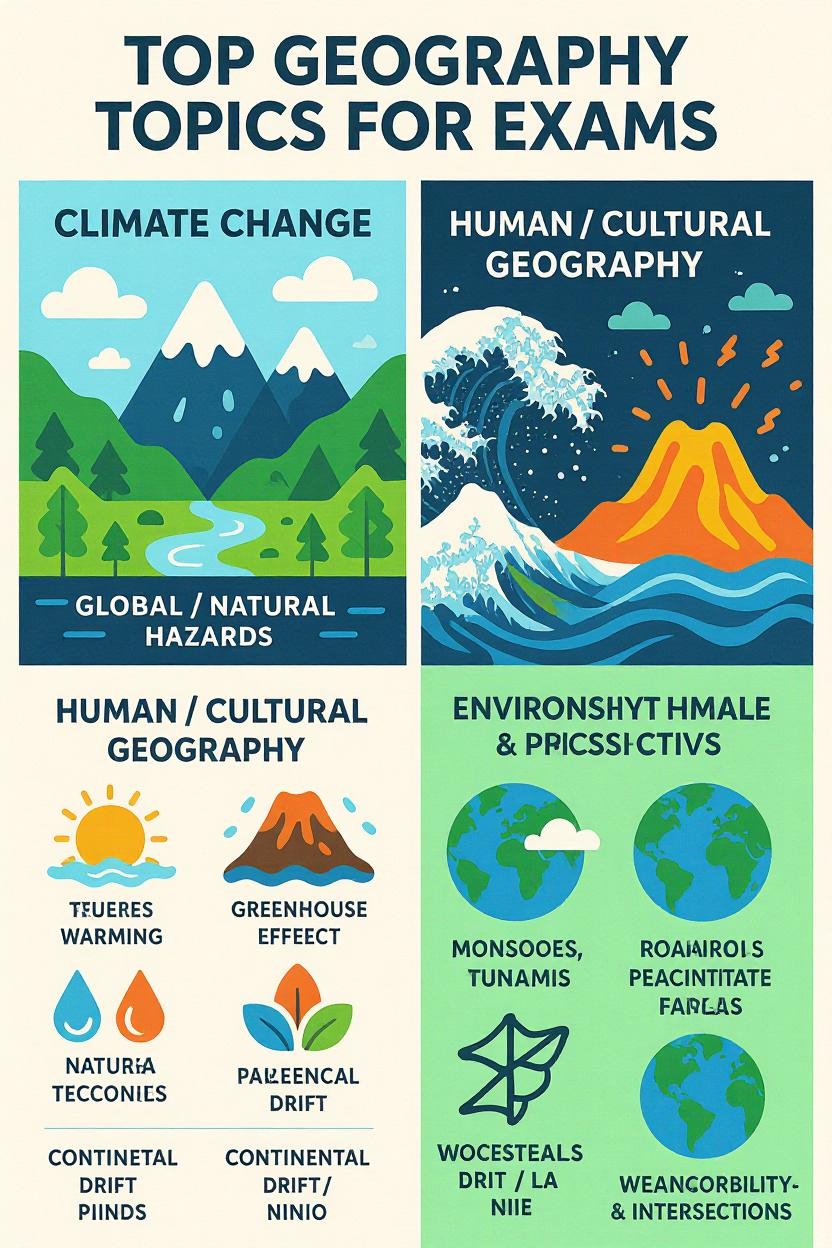
Natural disasters: earthquakes, volcanoes, tsunamis, floods.
Weather and climate patterns: monsoons, el Niño / la Niña, jet streams.
Oceans, sea level rise.
Glaciers, ice caps, polar regions.
Rivers, lakes, watersheds, and water management.
Soil types, landforms, deserts, and mountain ranges.
Human / Cultural / Political Geography
Migration, urbanization, population distribution.
Cities, their growth, megacities, slums.
Economic geography: agriculture, industry, natural resources.
Cultural geography: languages, religions, ethnic groups.
Geopolitics: borders, territorial disputes, political divisions.
Tourism geography: Sustainable tourism and travel trends.
Environment, Sustainability & Intersections
Biodiversity loss, species extinction, and conservation.
Forests, mangroves, ecosystems.
Sustainable development, green energy, renewable resources.
Human–environment interaction: how humans affect the environment & vice versa.
Water scarcity and water resource management.
Trending / Popular “Hook” Geography Topics
Maps, map-reading, GIS (Geographic Information Systems).
“Mysteries” or unusual physical geography phenomena.
Impact of climate on everyday life (rising heat, extreme weather).
Geography in news: e.g., places mentioned in current affairs (natural disasters, newly discovered islands, territorial claims).
Food Security and Agriculture in Changing Climates
Physical Geography & Natural Hazards
1. Climate Change, Global Warming, Greenhouse Effect
Climate Change: A long-term shift in global or regional climate patterns (e.g., increased extreme weather).
Global Warming: The specific, long-term increase in Earth’s average surface temperature, a major driver of climate change.
Greenhouse Effect: A natural process where gases in the atmosphere (like CO2, Methane, Water Vapor) trap heat, keeping the Earth warm. Human activities (burning fossil fuels, deforestation) have enhanced this effect, leading to accelerated global warming.
2. Natural Disasters
Earthquakes: Caused by the sudden release of energy along fault lines in the Earth’s crust. Measured on the Richter scale.
Volcanoes: Openings in the Earth’s crust through which molten rock (lava), ash, and gases erupt. Often found at tectonic plate boundaries.
Tsunamis: Giant sea waves generated by undersea earthquakes, volcanic eruptions, or landslides.
Floods: An overflow of water that submerges land that is usually dry. Causes include heavy rainfall, storm surges, and river overflow.
3. Plate Tectonics & Continental Drift
Continental Drift: The theory (by Alfred Wegener) that continents were once joined in a supercontinent (Pangaea) and have since “drifted” to their current positions.
Plate Tectonics: The modern theory that the Earth’s lithosphere (crust and upper mantle) is divided into large, moving plates. Their interaction (converging, diverging, transforming) causes mountains, earthquakes, and volcanoes.
4. Weather and Climate Patterns
Monsoons: Seasonal reversal of wind patterns that bring heavy rainfall to regions like South and Southeast Asia.
El Niño / La Niña: Opposite phases of the El Niño-Southern Oscillation (ENSO) cycle in the Pacific Ocean.
El Niño: Unusually warm ocean temperatures, disrupting global weather (causing droughts in some areas, floods in others).
La Niña: Unusually cool ocean temperatures, often with opposite effects of El Niño.
Jet Streams: Fast-flowing, narrow air currents in the atmospheres of some planets, including Earth. They influence weather patterns by steering storms and separating warm and cold air.
5. Oceans & Sea Level Rise
Oceans: Cover about 71% of the Earth’s surface and regulate global climate.
Sea Level Rise: Primarily caused by thermal expansion (water expanding as it warms) and the melting of glaciers and ice sheets. Threatens coastal communities and ecosystems.
6. Glaciers, Ice Caps, Polar Regions
Glaciers & Ice Caps: Massive, slow-moving rivers of ice. Their melting contributes to sea-level rise.
Polar Regions (Arctic & Antarctic): Act as the Earth’s “air conditioners.” The Arctic is an ice-covered ocean, while Antarctica is a ice-covered continent. They are warming faster than the global average (Polar Amplification).
7. Rivers, Lakes, Watersheds, and Water Management
Watershed (Drainage Basin): The area of land where all precipitation drains into a single river or lake system.
Water Management: The control and movement of water resources to minimize damage to life and property and to maximize efficient use. Includes dams, reservoirs, and conservation.
8. Soil Types, Landforms, Deserts, and Mountain Ranges
Soil Types: Vary by region (e.g., Alluvial, Black, Laterite). Influenced by climate, parent rock, and topography.
Landforms: Natural features of the Earth’s surface (e.g., mountains, plateaus, plains, valleys).
Deserts: Arid regions with low rainfall. Can be hot (Sahara) or cold (Gobi).
Mountain Ranges: Formed primarily by tectonic forces. Major ranges include the Himalayas, Andes, and Rockies.
Human / Cultural / Political Geography
1. Migration, Urbanization, Population Distribution
Migration: Movement of people from one place to another (can be internal/international, voluntary/forced).
Urbanization: The increasing percentage of a population living in urban areas (cities and towns).
Population Distribution: The pattern of where people live. Often uneven, influenced by physical geography, resources, and economy.
2. Cities, Megacities, Slums
Megacities: A metropolitan area with a population of over 10 million (e.g., Tokyo, Delhi, Shanghai).
Slums: Heavily populated urban informal settlements characterized by substandard housing, squalor, and lack of security of tenure.
3. Economic Geography
Agriculture: The cultivation of crops and rearing of animals. Types include subsistence and commercial.
Industry: The production of goods or related services within an economy. Location is influenced by resources, labor, and transport.
Natural Resources: Materials from the Earth that are used to support life and meet people’s needs (e.g., water, minerals, forests).
4. Cultural Geography
Languages, Religions, Ethnic Groups: The spatial distribution and interaction of cultural elements across the world.
5. Geopolitics
Borders & Political Divisions: The lines that define the territorial limits of a state.
Territorial Disputes: A disagreement over the possession/control of land between two or more states.
6. Tourism Geography
Sustainable Tourism: Tourism that takes full account of its current and future economic, social, and environmental impacts, addressing the needs of visitors, the industry, the environment, and host communities.
Environment, Sustainability & Intersections
1. Biodiversity Loss & Conservation
Biodiversity: The variety of life in the world or in a particular habitat or ecosystem.
Species Extinction: The permanent loss of a species. The current rate is 100-1000 times higher than the natural background rate, largely due to human activity.
Conservation: The preservation and careful management of the environment and natural resources.
2. Forests, Mangroves, Ecosystems
Ecosystem: A biological community of interacting organisms and their physical environment.
Mangroves: Salt-tolerant trees and shrubs that grow in coastal intertidal zones. They act as crucial nurseries for fish and buffer coastlines against storms and erosion.
3. Sustainable Development & Green Energy
Sustainable Development: “Development that meets the needs of the present without compromising the ability of future generations to meet their own needs.” (Brundtland Report)
Renewable Resources: Energy sources that are naturally replenished, such as solar, wind, hydro, and geothermal.
4. Human-Environment Interaction
How humans affect the environment (e.g., pollution, deforestation, urbanization).
How the environment affects humans (e.g., natural hazards, climate change, resource availability).
5. Water Scarcity
The lack of sufficient available water resources to meet the demands within a region. It is caused by overuse, pollution, and climate change.
Trending / Popular “Hook” Geography Topics
1. Maps & GIS
GIS (Geographic Information Systems): A computer system for capturing, storing, checking, and displaying data related to positions on Earth’s surface. Crucial for modern planning and analysis.
2. Unusual Physical Phenomena
Topics like “Ring of Fire” (Pacific earthquake/volcano zone), “Midnight Sun” (in polar regions), or mysterious sinkholes.
3. Impact of Climate on Everyday Life
Direct links such as rising urban heat, increased frequency of extreme weather events (heatwaves, floods), and impacts on agriculture and food security.
4. Geography in News
Always relevant. Connect geographical concepts to current events:
A major earthquake or hurricane -> Plate tectonics / Natural Hazards.
A new territorial dispute -> Geopolitics.
A report on melting Arctic ice -> Climate Change / Polar Regions.
Discovery of a new island -> Volcanism / Landforms.
Leave a Reply