• Skip to primary navigation
  • Skip to main content
  • Skip to footer

OHMSITE

News Blogs

  • Home
  • Tech Blogs
  • Non-Tech Blogs
  • Finance
  • About us
    • Privacy Policy
    • Contact us
    • Terms & Conditions
    • Disclaimer
      • Login
        • login page

kundan

Physics in Your Home: Electromagnetism, Relativity & Quantum Effects Explained

October 18, 2025 By kundan Leave a Comment

Physics Made Practical: The Hidden Science in Your Home

Physics in Your Home: Electromagnetism, Relativity & Quantum Effects Explained

When you hear the words “physics,” what comes to mind? Complex equations scribbled on a chalkboard? Lab coats and particle accelerators? While that’s part of it, the truth is far more exciting. Physics is the operating system of our everyday reality.

It’s the reason your phone charges without a cable, your food heats in minutes, and your GPS can guide you anywhere. Let’s pull back the curtain on some of the most fascinating physics principles that are working for you right now.

Part 1: The Magic of Electromagnetism in Action

Physics in Your Home: Electromagnetism, Relativity & Quantum Effects Explained

Electromagnetism is the powerful union of electricity and magnetism. It’s one of the fundamental forces of the universe, and we’ve learned to harness it in incredible ways.

How Your Microwave Oven Works (It’s Not Just “Radiation”)

At its heart, your microwave is a clever electromagnetism machine.

  • The Core Component: Inside every microwave is a device called a magnetron. This tube takes electrical energy and converts it into high-powered electromagnetic waves, specifically microwaves.

  • The Target: These microwaves are perfectly tuned to interact with one thing: water molecules. Water molecules are “polar,” meaning they have a positive and a negative end, like tiny magnets.

  • The Dance: The rapidly oscillating electromagnetic field from the magnetron causes these water molecules to flip back and forth billions of times per second. This frantic vibration generates heat through friction, which cooks your food from the inside out.

In a nutshell: Microwaves use electromagnetic waves to make water molecules vibrate, creating heat that cooks your food quickly and efficiently.

Cutting the Cord: Inductive Charging & Wireless Power

Tired of plugging in cables? You’re using electromagnetism.

  • The Basic Principle: These technologies rely on electromagnetic induction, discovered by Michael Faraday. Simply put, a changing magnetic field can create an electric current in a nearby wire.

  • How it Works:

    1. Your charging pad has a coil of wire inside. When you plug it in, an alternating electric current (AC) flows through this coil, creating a fluctuating magnetic field around it.

    2. Your phone (or toothbrush) has its own coil of wire built into the back.

    3. When you place the phone on the pad, the magnetic field from the pad “cuts” across the coil in your phone.

    4. This action induces an electric current in your phone’s coil, which is then converted to direct current (DC) to charge the battery.

In a nutshell: A wireless charger creates an invisible magnetic field that transfers energy directly to your device’s battery, no physical connection needed.

Part 2: Demystifying the “Spooky” Physics

Physics in Your Home: Electromagnetism, Relativity & Quantum Effects Explained

Beyond our everyday gadgets, physics gets even weirder and more wonderful. Let’s break down two concepts that sound intimidating but are actually grounded in our reality.

Demystifying Relativity: It’s All Relative (and in Your GPS)

Albert Einstein’s theory of relativity isn’t just for astronauts. It’s correcting your drive to the grocery store right now.

  • Special Relativity: This tells us that time isn’t absolute. The faster you move, the slower time passes for you relative to someone who is stationary. This is called time dilation.

  • The GPS Connection: GPS satellites orbit the Earth at thousands of miles per hour. Due to Special Relativity, the atomic clocks on these satellites run slower than clocks on the ground by about 7 microseconds per day.

  • General Relativity: This adds gravity to the mix. It says that gravity also warps time. Since the satellites are in a weaker gravitational field than Earth’s surface, their clocks run faster due to General Relativity by about 45 microseconds per day.

The net effect is that the satellites’ clocks gain about 38 microseconds per day. Without correcting for both of Einstein’s theories, your GPS would be off by several miles within a single day!

The Takeaway: Relativity isn’t an abstract idea; it’s a practical engineering problem that must be solved for modern technology to work accurately.

Demystifying Quantum Effects: The Weird World of the Very Small

Quantum mechanics rules the world of atoms and particles, and its behavior is bizarre but incredibly useful.

  • Quantum Superposition: You’ve heard the famous thought experiment: Schrödinger’s Cat is both alive and dead until you open the box. This illustrates superposition—the idea that a quantum system can exist in multiple states at once until it is measured.

  • The Practical Use: Quantum Computers. Unlike classical computers that use bits (0 or 1), quantum computers use qubits. A qubit can be a 0, a 1, or both at the same time (superposition). This allows them to perform a massive number of calculations simultaneously, solving problems that are impossible for today’s supercomputers.

  • The Photoelectric Effect: This is how your solar panels and smartphone camera sensors work. Einstein showed that light isn’t just a wave; it also comes in little packets of energy called photons.

    • When a photon with enough energy hits certain materials (like silicon in a solar panel), it can knock an electron loose, creating an electric current.

    • In your camera sensor, this “knocked loose” electron is counted as a single point of light (a pixel) to build your digital image.

The Takeaway: Quantum mechanics isn’t just philosophy; it’s the physics behind the technologies that are shaping our future, from renewable energy to artificial intelligence.


The Universe is in Your Kitchen

The next time you heat up leftovers, charge your phone wirelessly, or use a map on your phone, take a moment to appreciate the invisible forces at work. From the electromagnetic dance in your microwave to the relativistic corrections in space and the quantum magic in your camera, physics isn’t just in a textbook—it’s the framework of your modern life.

What everyday technology amazes you the most? Share your thoughts in the comments below!


Frequently Asked Questions (FAQs)

1. Is it safe to stand in front of a microwave while it’s running?
Yes, modern microwaves are designed with strict safety standards and shielding that contains the microwaves inside the oven. The small amount of radiation that might leak is far below the level known to harm people.

2. Why can’t I charge my phone wirelessly if it’s slightly off the pad?
Wireless charging relies on close proximity for efficient electromagnetic induction. If the coils in the charger and your phone are too far apart, the magnetic field weakens significantly and fails to induce a sufficient current to charge the battery.

3. Do all phones support wireless charging?
No, not all phones support it. The phone must have the necessary internal charging coil and hardware to support the Qi (pronounced “Chee”) standard, which is the most common technology for inductive charging.

4. If relativity affects time, why don’t we notice it in daily life?
The effects of relativity are incredibly tiny at the speeds and gravitational forces we experience on Earth. They only become significant at very high velocities (close to the speed of light) or in very strong gravitational fields, which is why they are crucial for precise systems like GPS satellites.

5. How exactly does my GPS use relativity to be accurate?
The GPS satellites’ clocks run faster due to weaker gravity (General Relativity) and slower due to their high speed (Special Relativity). The net effect is a gain of about 38 microseconds per day. Engineers pre-program this correction into the system; without it, your GPS would be off by several miles in a single day.

6. Is Schrödinger’s Cat a real experiment?
No, it was a thought experiment designed by Erwin Schrödinger to highlight what he saw as the absurdity of applying quantum superposition (a property of particles) to large-scale, everyday objects. It was meant to provoke discussion, not to be performed in a lab.

7. What’s the main difference between a normal computer and a quantum computer?
A normal computer uses bits that are either 0 or 1. A quantum computer uses qubits (quantum bits), which can be 0, 1, or both at the same time (a state called superposition). This allows quantum computers to explore many possibilities simultaneously.

8. How is a photon related to a beam of light?
A beam of light is a stream of countless tiny, discrete packets of energy called photons. Think of a photon as a single “particle” of light.

9. Why do some materials work for solar panels and others don’t?
This is due to the photoelectric effect. A material must have electrons that can be knocked loose by the energy of incoming photons from sunlight. Silicon is perfect for this because its electrons require an amount of energy that photons in visible light can provide.

10. Are there other everyday uses for electromagnetism?
Absolutely! Electromagnetism is everywhere: in the speakers that make sound, the motors that spin in your blender or vacuum cleaner, the MRI machines in hospitals, and the electromagnets in junkyards that lift heavy cars.


Multiple Choice Questions (MCQs)

1. What is the primary component in a microwave oven that generates the microwaves?
a) Transformer
b) Diode
c) Magnetron
d) Capacitor

2. Wireless charging primarily works on the principle of:
a) Quantum Tunneling
b) Electromagnetic Induction
c) Static Electricity
d) Radioactive Decay

3. The primary quantum effect that allows a quantum computer’s qubit to be in multiple states at once is called:
a) The Photoelectric Effect
b) Superposition
c) Entanglement
d) Relativity

4. According to the blog, why is the Theory of Relativity crucial for the GPS in your smartphone?
a) It helps the GPS find a satellite signal faster.
b) It calculates the shortest route using curved spacetime.
c) It corrects time discrepancies in satellite clocks to ensure accuracy.
d) It allows the GPS to work without an internet connection.

5. What molecule in food do microwaves primarily target to create heat?
a) Fat Molecules
b) Water Molecules
c) Sugar Molecules
d) Protein Molecules

6. The photoelectric effect, explained by Einstein, demonstrates that light behaves as:
a) Only a wave
b) A particle (a photon)
c) Neither a wave nor a particle
d) A continuous stream of energy

7. In the context of wireless charging, what creates the magnetic field?
a) The battery in your phone
b) A small magnet in the pad
c) An alternating current running through a coil in the charging pad
d) The Earth’s magnetic field

8. Which theory of relativity explains why gravity affects the passage of time?
a) General Relativity
b) Special Relativity
c) Quantum Relativity
d) Newtonian Relativity

9. Schrödinger’s Cat was a thought experiment designed to illustrate the paradoxes of:
a) General Relativity
b) Electromagnetism
c) Quantum Superposition
d) Thermodynamics

10. What everyday device relies on the photoelectric effect to convert light into electricity?
a) A LED Light Bulb
b) A Solar Panel
c) A Toaster
d) A Fluorescent Lamp


Answer Key for MCQs:

  1. c, 2. b, 3. b, 4. c, 5. b, 6. b, 7. c, 8. a, 9. c, 10. b

Read Tech Blog…

Filed Under: Electrical, Tech Blogs Tagged With: #electromagnetism, #howitworks, #microwave, #physics, #quantumphysics, #relativity, #WirelessCharging, science, technology

5 Biggest Astrophysics Mysteries Shaking Our Understanding of the Universe

October 17, 2025 By kundan Leave a Comment

5 Biggest Astrophysics Mysteries Shaking Our Understanding of the Universe

Astrophysics Mysteries

Look up at the night sky, and you’re seeing a cosmic performance where most of the actors and the script are still unknown. Modern astrophysics and cosmology have uncovered a universe far stranger and more wonderful than we ever imagined, yet they are defined by profound mysteries that challenge the very foundations of physics.

Here are the frontiers where our knowledge ends and the true adventure begins.

1. The Ghost in the Cosmic Machine: The Hunt for Dark Matter

Astrophysics Mysteries

We know it’s there. Its gravitational pull holds galaxies together and sculpts the large-scale structure of the cosmos. But we have no idea what it is. Dark matter makes up about 27% of the universe, yet it is completely invisible, neither emitting nor absorbing light.

Dark Matter Detection Methods: How We’re Hunting the Invisible

Scientists are using a multi-pronged approach to catch this elusive ghost:

  • Direct Detection: Experiments like LUX-ZEPLIN and XENONnT are located deep underground to shield from cosmic rays. They use massive vats of ultra-pure liquid xenon, hoping that a dark matter particle will, on very rare occasions, bump into an atomic nucleus and create a tiny flash of light or charge that we can detect.

  • Indirect Detection: Telescopes in space and on Earth scan the skies for excess gamma rays, neutrinos, or other signals that could be produced when dark matter particles annihilate or decay. The Fermi Gamma-ray Space Telescope is a key player in this hunt.

  • Collider Creation: The Large Hadron Collider (LHC) smashes protons together at near light-speed, attempting to create dark matter particles directly from the immense energy of the collisions.

2. The Ultimate Cosmic Shredder: The Black Hole Information Paradox

Astrophysics Mysteries

Black holes are regions of spacetime where gravity is so strong that not even light can escape. According to Einstein’s general relativity, if you throw something into a black hole, all that remains is mass, charge, and spin—everything else about the object (its “information”) is lost forever. But quantum mechanics has a fundamental rule: information cannot be destroyed.

This is the Black Hole Information Paradox: a direct contradiction between our two most successful theories of physics.

What’s the Solution?

The leading candidate is the “black hole firewall” paradox or, more elegantly, the idea from string theory that information isn’t lost inside the hole but is somehow encoded on its event horizon (the “point of no return”) and slowly leaked back out via Hawking radiation. Solving this is crucial for finding a unified “Theory of Everything.”

3. Listening to the Ripples in Spacetime: Gravitational Waves & Multi-Messenger Astronomy

Astrophysics Mysteries

In 2015, the LIGO observatory made a monumental discovery: it directly detected gravitational waves—ripples in the fabric of spacetime caused by cataclysmic events like merging black holes, predicted by Einstein a century ago.

What Are Gravitational Waves?

Imagine spacetime as a stretched rubber sheet. Massive accelerating objects (like orbiting neutron stars) create waves on this sheet, much like a spinning bowling ball would. These waves stretch and compress space itself as they pass through us.

The New Era of Multi-Messenger Astronomy

This was the beginning of a new era. For the first time, we weren’t just “seeing” the universe with light (photons); we were “feeling” its vibrations. This culminated in a 2017 event where gravitational waves from two merging neutron stars were detected, and seconds later, telescopes across the globe saw the corresponding flash of light and gamma-ray burst.

This multi-messenger astronomy—combining light, gravitational waves, and neutrinos—is like watching a movie with both the picture and the sound on, giving us a complete and revolutionary view of the most violent events in the cosmos.

Conclusion: The Universe is Weirder Than We Know

The fact that over 95% of the universe is made of mysterious dark matter and dark energy, that black holes threaten to break physics, and that we can now listen to the cosmos through gravitational waves, tells us one thing: we are living in a golden age of cosmology.

These aren’t just academic puzzles. They are the keys to unlocking a deeper understanding of reality itself. The greatest discoveries in astrophysics are yet to come, and they will likely be even more shocking than we can imagine.


Frequently Asked Questions (FAQ)

Q: What is the difference between astrophysics and cosmology?
A: Astrophysics is the physics of individual celestial objects (like stars, galaxies, and black holes). Cosmology is the study of the origin, evolution, and ultimate fate of the entire universe as a whole.

Q: Has dark matter ever been directly detected?
A: No, not yet. While the gravitational evidence for its existence is overwhelming, a definitive direct detection of a dark matter particle remains one of the biggest unsolved goals in physics.

Q: What happens to information inside a black hole?
A: We don’t know! This is the core of the black hole information paradox. The leading theories suggest it is not destroyed but is preserved in some form, either on the surface or through the radiation the black hole emits.

Q: How do gravitational wave detectors like LIGO work?
A: LIGO uses two long, L-shaped tunnels with lasers bouncing down them. A passing gravitational wave minutely changes the length of the arms, and the ultra-sensitive instruments detect this tiny change in the laser light, confirming a wave has passed.


Test Your Knowledge: Astrophysics Mysteries MCQ

1. What is the primary evidence for the existence of dark matter?
a) It emits X-rays
b) We have photographed it
c) Its gravitational effects on galaxies and galaxy clusters
d) It causes red shift

2. The Black Hole Information Paradox is a conflict between which two theories?
a) Newtonian Mechanics and General Relativity
b) General Relativity and Quantum Mechanics
c) Thermodynamics and Electromagnetism
d) Special Relativity and String Theory

3. What historic 2017 event launched the era of multi-messenger astronomy?
a) A supernova in a nearby galaxy
b) The detection of both gravitational waves and light from merging neutron stars
c) The discovery of a new planet in the habitable zone
d) The first image of a black hole’s event horizon

4. What do gravitational waves directly do?
a) Create sound we can hear
b) Stretch and compress the fabric of spacetime
c) Push particles through space
d) Generate visible light

Quantum Technology

Filed Under: Electrical, Tech Blogs

Quantum Technologies: 5 Ways They Will Revolutionize Our World

October 17, 2025 By kundan Leave a Comment

Quantum Technologies: 5 Ways They Will Revolutionize Our World

Quantum Technologies

For decades, “quantum” was a word confined to physics labs. Today, it’s at the forefront of a technological revolution poised to reshape everything from medicine to cybersecurity. But what are quantum technologies?
and why do they matter?

This isn’t just science fiction. We’re on the cusp of a new era driven by the strange and powerful rules of quantum mechanics. Let’s break down the three pillars set to change our world: Quantum Sensing, Quantum Computing, and Quantum Materials.

1. Quantum Sensing: A New Lens on Reality

Imagine a sensor so precise it can detect tiny changes in gravity or magnetic fields. That’s the promise of quantum sensing.

The Technique: Harnessing Quantum States

At its core, quantum sensing uses individual particles like atoms or photons (particles of light) as ultra-sensitive probes. These quantum particles exist in a delicate state called a “superposition,” meaning they can be highly sensitive to the smallest disturbances in their environment. By measuring how these states change, we can detect things with unprecedented accuracy.

Revolutionary Applications of Quantum Sensing:

  • Brain Imaging (MEG): Replace bulky MRI machines with wearable sensors that map brain activity with millimetre precision, revolutionizing neuroscience and surgery.

  • Navigation: Create GPS-free navigation systems for submarines and autonomous vehicles that work anywhere, even underground or underwater.

  • Medical Diagnostics: Develop devices that can detect early-stage diseases, like cancer, by spotting minuscule magnetic signals from the body.

  • Infrastructure Monitoring: Locate underground pipes, cables, and cavities without any digging, saving time and money on city maintenance.

2. Quantum Computing: The End of the Binary Era

Quantum Computing: The End of the Binary Era

You’ve probably heard of quantum computing, but what does it mean for a beginner?

The Basics: Beyond 0s and 1s

Classical computers use bits—tiny switches that are either ON (1) or OFF (0). Quantum computers use quantum bits, or qubits.

Thanks to the quantum principle of superposition, a qubit can be a 0, a 1, or both at the same time. This ability to be in multiple states simultaneously, combined with another property called entanglement (where qubits are linked regardless of distance), gives quantum computers immense parallel processing power.

The Physics for Beginners:

Think of it like this:

  • A Classical Bit: A coin that is either heads or tails.

  • A Qubit: A spinning coin. While it’s spinning, it’s effectively both heads and tails. It only “decides” on one state when you stop it to look (this is called “measurement”).

This allows a quantum computer to explore a vast number of possibilities all at once, solving problems that are practically impossible for even the largest supercomputers of today.

What Could We Do With It?

  • Drug Discovery: Simulate complex molecules to design new life-saving drugs and materials.

  • Financial Modeling: Optimize investment portfolios and manage risk by analyzing countless market variables.

  • Climate Change: Model complex climate systems to find better solutions for carbon capture.

  • Cryptography: Break current encryption (a threat) but also create unhackable quantum communication networks (a solution).

3. Quantum Materials: The Building Blocks of the Future

Quantum Technologies

You can’t have quantum technologies without the right materials. Quantum materials are substances engineered to exhibit exotic electronic and quantum properties.

What Are They?

These are materials where quantum mechanical effects dominate their behavior, leading to unique capabilities not found in conventional materials like silicon or copper.

The Star Players: Graphene and 2D Materials

  • Graphene: A single layer of carbon atoms arranged in a honeycomb lattice. It’s incredibly strong, lightweight, flexible, and an excellent conductor of electricity and heat. Its unique 2D structure gives it these “super” properties.

  • Beyond Graphene: Scientists are now exploring hundreds of other 2D materials, like transition metal dichalcogenides (TMDs), which have unique optical and electronic properties perfect for building ultra-thin, flexible sensors and novel qubits for quantum computers.

Why They Matter:

These materials are the essential hardware for the quantum future. They are used to build more stable qubits, create highly sensitive sensors, and develop new types of low-energy electronics.

Conclusion: A Quantum Future is Closer Than You Think

The race in quantum technologies is a global one, with governments and tech giants investing billions. While full-scale quantum computing might still be years away, quantum sensors are already entering the market, and quantum materials like graphene are being integrated into products today.

Understanding these technologies is no longer just for physicists. They represent the next great leap forward, and their impact will be felt across every industry. The quantum age is dawning.


Frequently Asked Questions (FAQ)

Q: What is the simplest definition of quantum technology?
A: Quantum technology is a class of technology that works by exploiting the unique properties of quantum mechanics, such as superposition and entanglement, to achieve performance that is impossible with classical physics.

Q: When will quantum computers be available to the public?
A: Widespread, fault-tolerant quantum computing is likely still 10-15 years away. However, companies like IBM and Google already offer cloud access to their early-stage quantum processors for research.

Q: What is a real-world example of a quantum material?
A: Graphene is the most famous real-world example. It’s a single layer of carbon atoms that is stronger than steel, transparent, and an excellent conductor.

Q: Are quantum sensors being used today?
A: Yes! While still advancing rapidly, early quantum sensing devices are already used in specialized medical research (like magnetoencephalography) and for precision navigation.


Test Your Knowledge: Quantum Technologies MCQ

1. What property allows a qubit to be both 0 and 1 simultaneously?
a) Entanglement
b) Superposition
c) Interference
d) Decoherence

2. Which quantum technology is most likely to revolutionize brain imaging in the near future?
a) Quantum Computing
b) Quantum Sensing
c) Quantum Materials
d) Quantum Cryptography

3. Graphene is a famous example of what?
a) A Qubit
b) A Quantum Algorithm
c) A Quantum Material
d) A Quantum Sensor

4. What is a major potential application of quantum computing?
a) Creating more sensitive GPS
b) Simulating complex molecules for drug discovery
c) Making thinner smartphone screens
d) Increasing internet bandwidth

Filed Under: Electrical, Tech Blogs

The 4 Types of Evidence That Proved Continental Drift Was Real

October 17, 2025 By kundan Leave a Comment

Continental Drift: The Groundbreaking Theory That Explained Our World

Continental Drift

Look at a map of the world. Have you ever noticed that the coastlines of South America and Africa look like they could fit together? This isn’t a coincidence—it’s the most famous clue that launched a scientific revolution. The story of continental drift is a tale of one man’s brilliant intuition, decades of rejection, and its ultimate triumph as the foundation for our modern understanding of the Earth.

This is the story of how a jigsaw puzzle map evolved into the powerful theory of plate tectonics.

What is the Continental Drift Theory?

In the early 20th century, German meteorologist Alfred Wegener proposed a radical idea. In his 1915 book, The Origin of Continents and Oceans, he hypothesized that the Earth’s continents were not fixed in place. Instead, he suggested that about 300 million years ago, all the continents were joined together in a single, massive supercontinent called Pangea (meaning “all Earth”).

Wegener’s continental drift theory proposed that over millions of years, Pangea broke apart, and the continents slowly “drifted” to their current positions. He believed this movement was still ongoing.

Alfred Wegener’s Evidence for Continental Drift

Wegener didn’t just have a hunch; he compiled a compelling body of evidence from across different scientific fields. His key proofs for continental drift included:

1. The Jigsaw Fit

The most obvious clue was the remarkable fit of the continents, particularly the Atlantic coastlines of South America and Africa.

2. Fossil Evidence

How could the same fossilized plants and animals be found on continents separated by vast oceans?

  • The freshwater reptile Mesosaurus was found only in eastern South America and southern Africa.

  • The fern-like plant Glossopteris left its fossils across South America, Africa, India, Antarctica, and Australia.

Land bridges were the old explanation, but Wegener’s theory provided a more elegant solution: these continents were once connected.

3. Geologic and Rock Formations

Mountain belts and rock sequences matched up perfectly across oceans. The Appalachian Mountains of North America, for instance, lined up geologically with mountains in Scotland and Scandinavia when the continents were reassembled into Pangea.

4. Paleoclimatic Evidence

Wegener found evidence of ancient climates that didn’t match a continent’s current location. For example:

  • Glacial deposits from a past ice age were found in warm regions like India, South Africa, and Australia.

  • Coal deposits (which form in tropical swamps) were discovered in cold climates like Antarctica.

On a Pangea map, these anomalies made perfect sense, as these continents were once located near the South Pole and equator, respectively.

Why Was the Continental Drift Theory Initially Rejected?

Continental Drift: The Groundbreaking Theory That Explained Our World

Despite the compelling evidence, Alfred Wegener’s continental drift hypothesis was widely mocked and rejected by the scientific community for decades. The biggest problem was the “How?”.

Wegener proposed that continents plowed through the ocean floor like ships through ice, driven by the Earth’s rotation and tidal forces. Geophysicists quickly calculated that these forces were far too weak to move massive continents. Without a plausible mechanism, the entire theory of continental drift was dismissed as mere speculation.

From Continental Drift to Plate Tectonics: A Vindication

Wegener died in 1930, never seeing his idea accepted. It wasn’t until the 1950s and 1960s that new evidence emerged, leading to the theory of plate tectonics—the modern successor to continental drift.

Key discoveries included:

  • Seafloor Spreading: Mapping of mid-ocean ridges revealed that new oceanic crust was being formed, pushing plates apart.

  • Paleomagnetism: The magnetic history of ocean floor rocks provided a recorded “tape” of the continents moving over time.

Scientists realized that Wegener was right about the “what” (continents move) but wrong about the “how.” They discovered that continents don’t plow through the ocean; they are passengers on massive, moving tectonic plates.

Conclusion: Wegener’s Legacy

While the term “continental drift” has been largely superseded by “plate tectonics,” its importance cannot be overstated. Alfred Wegener was a visionary who saw the big picture that others missed. He connected the dots across disciplines and challenged a fixed, unchanging view of our planet.

His work is a powerful reminder that science often advances through bold ideas that, even if incomplete, point the way toward a greater truth. The next time you look at a world map, remember that it’s just a snapshot in a long, dynamic, and incredible journey.


Frequently Asked Questions About Continental Drift

Q: What is the main difference between continental drift and plate tectonics?
A: Continental drift was the original hypothesis that continents move. Plate tectonics is the comprehensive theory that explains how they move—on large plates of lithosphere that include both continents and ocean basins, driven by mantle convection.

Q: What was the name of the supercontinent?
A: The supercontinent proposed by Alfred Wegener was called Pangea.

Q: What was the main reason scientists rejected Wegener’s theory?
A: The primary reason for rejection was that Wegener could not provide a convincing mechanism for how the continents moved. The forces he proposed were proven to be far too weak.

Q: Are the continents still drifting today?
A: Yes! Using GPS technology, we can now measure the continents moving at about the same speed your fingernails grow. The Atlantic Ocean is still widening, and the Himalayas are still rising.


Test Your Knowledge: Continental Drift MCQ

1. Who first proposed the theory of continental drift?
a) Charles Darwin
b) Isaac Newton
c) Alfred Wegener
d) James Hutton

2. What was the name of the ancient supercontinent?
a) Gondwana
b) Laurasia
c) Pangea
d) Tethys

3. Which of the following was NOT used as evidence for continental drift?
a) Fossil matches
b) Rock formation matches
c) Satellite images of plate movement
d) Paleoclimatic evidence
(Explanation: Satellite technology came decades after Wegener’s theory.)

4. The modern theory that developed from continental drift is:
a) Seafloor Spreading
b) Plate Tectonics
c) Continental Shift

Filed Under: Geography, Non-Tech Blogs

The 3 Biggest Impacts of Plate Tectonics: From Creation to Destruction

October 17, 2025 By kundan Leave a Comment

The Theory of Plate Tectonics: Earth’s Unseen Engine.

plate tectonics

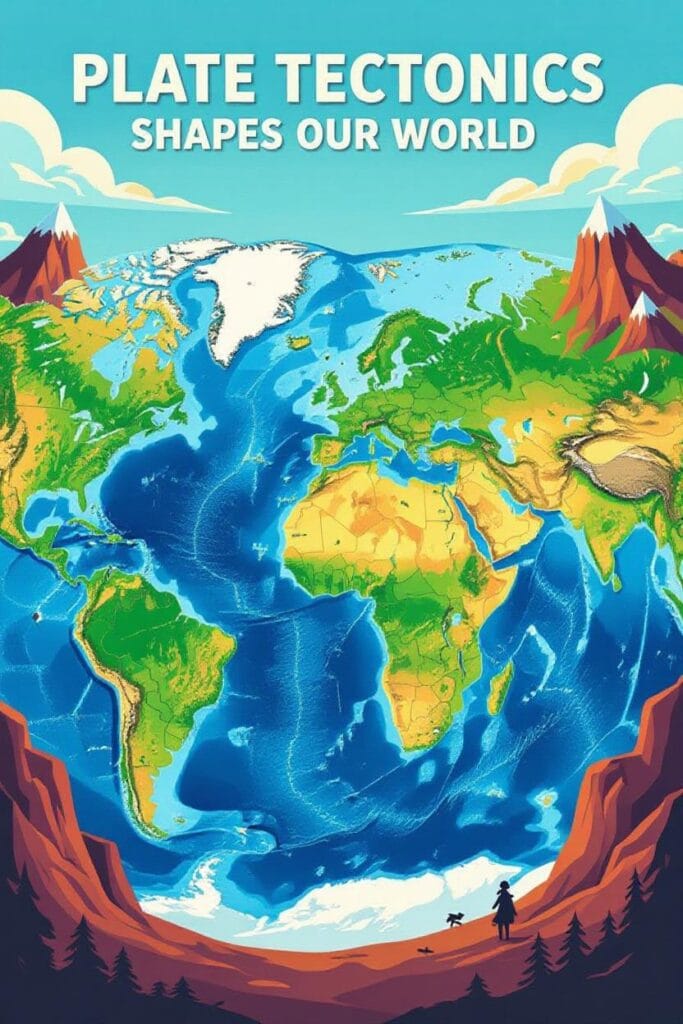
Look at a map of the world. Have you ever noticed how the coastlines of South America and Africa look like they could fit together, like pieces of a giant jigsaw puzzle? This isn’t a coincidence. It’s the most visible clue to one of the most powerful and fundamental forces shaping our planet: Plate Tectonics.

For centuries, this was just a curious observation. Today, we know it’s the key to understanding nearly everything about Earth’s geography, from the highest mountains to the deepest ocean trenches, and even why we have earthquakes and volcanoes.

So, what exactly is this grand, geological dance?

The Basics: Earth’s Skin is Cracking

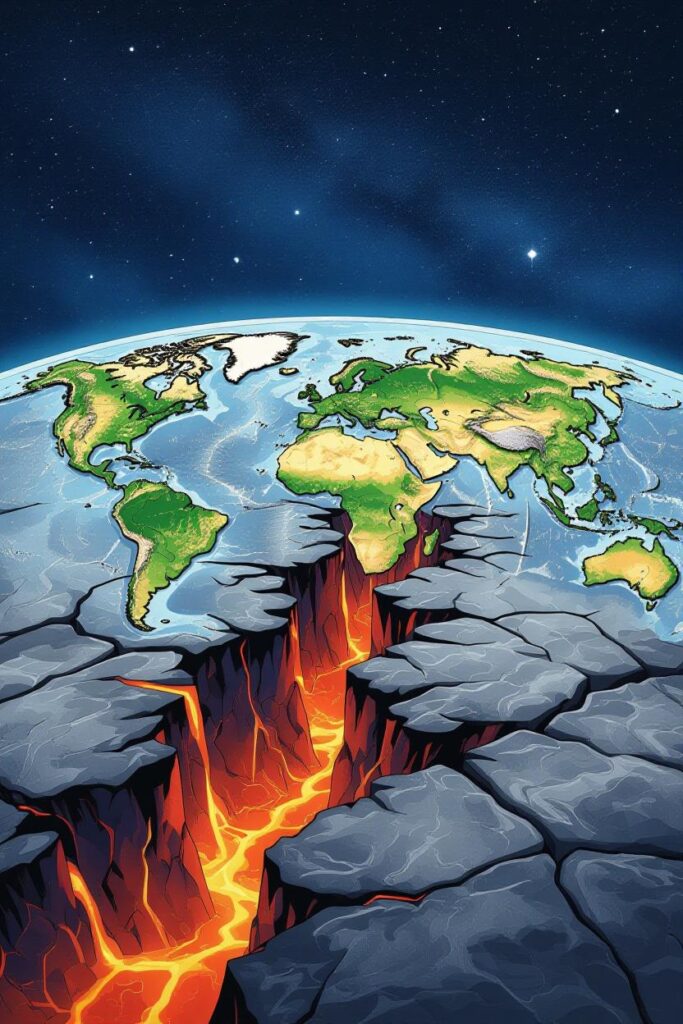
Imagine the Earth is a hard-boiled egg. The shell isn’t one solid piece; it’s cracked into several fragments. The Earth’s outer layer, the lithosphere, is the same. It’s broken into massive, irregularly shaped slabs of rock called tectonic plates. These plates are not stationary; they are constantly moving, floating on the hot, semi-fluid layer of the mantle beneath them.

This movement is slow—about the same speed your fingernails grow—but over millions of years, it has completely reshaped the face of our planet.

The Three Main Moves: Boundaries

The real action happens where these plates meet. These borders, called plate boundaries, are the epicenters of Earth’s most dramatic geological events. There are three main types of interactions:

1. Divergent Boundaries: The Creators

plate tectonics

  • What happens: Two plates pull away from each other.

  • The Result: As they separate, magma from the mantle rises to fill the gap, creating new crust. This mostly happens under the oceans at mid-ocean ridges, forming vast underwater mountain ranges. On land, this process can create massive rift valleys, like the East African Rift.

  • Think of it as: The Earth’s crust being stretched thin, like pulling apart a piece of warm toffee.

2. Convergent Boundaries: The Destroyers (and Builders)

plate tectonics

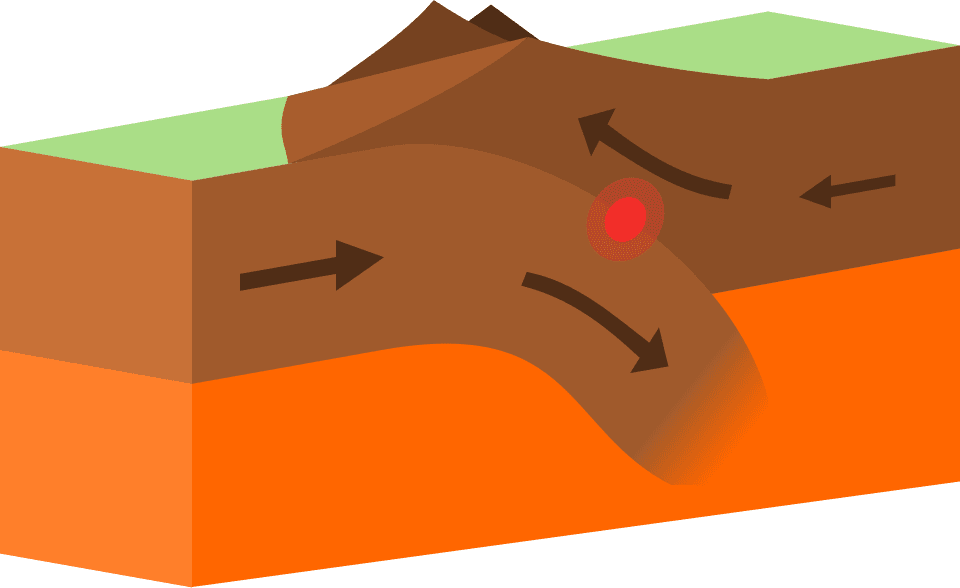
  • What happens: Two plates collide. This is where things get explosive, and the outcome depends on the type of crust involved.

    • Oceanic vs. Continental: The denser oceanic plate slides beneath the continental plate in a process called subduction. This creates a deep ocean trench and forces molten rock upward, fueling massive chains of volcanoes on the continent, like the Andes or the Cascades.

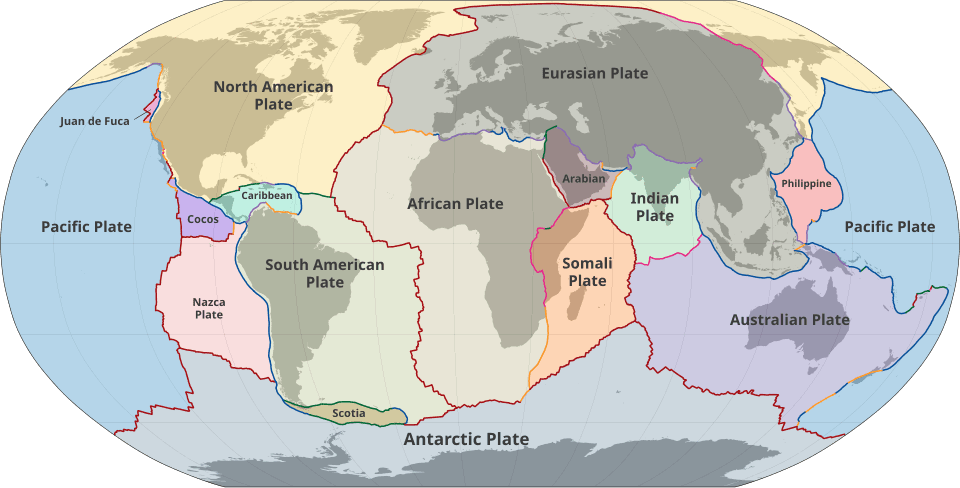
    • Continental vs. Continental: Neither plate wants to sink, so they crumple and fold, pushing Earth’s crust upward to form towering mountain ranges. The Himalayas, home to Mount Everest, are the spectacular result of the Indian plate smashing into the Eurasian plate.

  • Think of it as: A slow-motion car crash on a planetary scale.

3. Transform Boundaries: The Grinders

plate tectonics

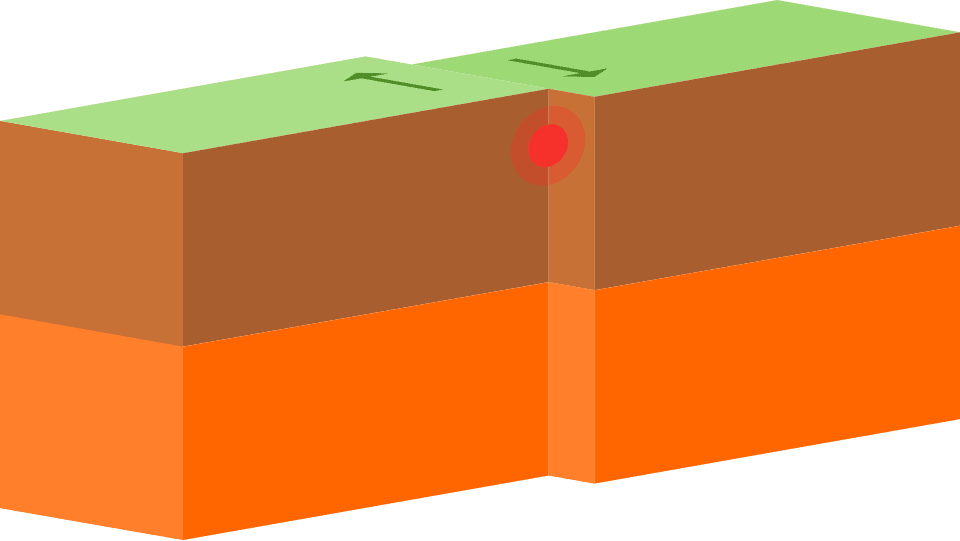
  • What happens: Two plates slide past one another horizontally.

  • The Result: They don’t slide smoothly. The plates get stuck, build up immense pressure, and then suddenly lurch forward, releasing energy as an earthquake. The most famous example is the San Andreas Fault in California, where the Pacific Plate is grinding past the North American Plate.

  • Think of it as: Rubbing two rough blocks of wood together—they stick, slip, and stick again.

Why Should You Care? The Power of a Unified Theory

Before the theory of plate tectonics was widely accepted in the 1960s, geologists struggled to explain how the same fossil could be found on continents separated by vast oceans. Plate tectonics provided the missing link. It’s the grand unifying theory of geology that explains:

  • The Distribution of Earthquakes and Volcanoes: Plot them on a map, and they will almost perfectly outline the plate boundaries. This knowledge is crucial for hazard preparedness and saving lives.

  • The Formation of Mountains and Oceans: It answers the “how” behind the world’s most iconic landscapes.

  • The Recycling of Earth’s Crust: The planet is in a constant state of renewal. New crust is created at divergent boundaries, while old crust is destroyed at convergent ones. This cycle is essential for regulating Earth’s climate and chemistry over geological time.

  • The History of Life: By moving continents, plate tectonics has changed ocean currents and global climate, creating and destroying habitats and driving the evolution of life. It’s the reason Australia has such unique wildlife!

A Planet in Motion

plate tectonics

The ground beneath our feet feels solid and permanent. But plate tectonics reveals a different truth: we are living on a dynamic, ever-changing planet. The Atlantic Ocean is still widening, the Himalayas are still rising, and California will one day (in millions of years) be a suburb of Alaska.

It’s a humbling and powerful reminder that our world is alive with geological forces that operate on a timescale far beyond our own. The next time you feel an earthquake, see a volcanic eruption on the news, or simply look at a world map, remember the incredible, unseen engine driving it all.


FAQs on Plate Tectonics

1. What is the “engine” that drives plate tectonics?
The primary driving force is the heat from Earth’s interior. The mantle, though mostly solid, can flow very slowly over geological time due to this heat, creating convection currents. These currents act like a conveyor belt, dragging the tectonic plates along. The weight of a subducting (sinking) plate also helps pull the rest of the plate behind it.

2. How many tectonic plates are there?
There are seven or eight major plates (e.g., Pacific, North American, African, Eurasian) and many more minor microplates (e.g., Juan de Fuca, Cocos, Caribbean). The exact number can vary slightly depending on how scientists define the boundaries of smaller plates.

3. Can plate tectonics cause tsunamis?
Yes, absolutely. The most powerful tsunamis are generated by large earthquakes at subduction zones, where one plate lurches underneath another, violently displacing a massive amount of water.

4. Was there life on Earth before plate tectonics started?
This is a topic of active research. Plate tectonics as we know it likely began around 3 billion years ago. Life existed before that, but it was mostly microscopic and in the oceans. The start of plate tectonics was crucial for creating diverse environments and regulating the climate, which may have paved the way for more complex life.

5. Do the other planets in our solar system have plate tectonics?
As far as we know, Earth is the only planet with active plate tectonics. Venus shows some evidence of past tectonic activity, but it seems to have stalled. Mars has a static, single-plate crust. This uniqueness is a key reason why Earth is so geologically active and habitable.

6. Will the continents ever collide again?
Yes! Based on the current direction of plate movements, scientists project that in about 250 million years, the continents will merge again to form a new supercontinent, sometimes called Pangaea Proxima or Neopangaea.


MCQs on Plate Tectonics

1. The theory that describes the large-scale motion of Earth’s lithosphere is called:
a) Continental Drift
b) Seafloor Spreading
c) Plate Tectonics
d) Mantle Convection

Answer: c) Plate Tectonics
Explanation: While Continental Drift was the precursor idea, Plate Tectonics is the comprehensive modern theory that includes seafloor spreading and mantle convection as key mechanisms.

2. Which of the following is a result of two continental plates colliding at a convergent boundary?
a) A mid-ocean ridge
b) A deep ocean trench
c) A volcanic island arc
d) A massive mountain range

Answer: d) A massive mountain range
Explanation: When two buoyant continental plates collide, neither can sink easily. Instead, they crumple and fold, pushing up the crust to form vast mountain ranges like the Himalayas.

3. The San Andreas Fault in California is a famous example of what type of plate boundary?
a) Divergent
b) Convergent
c) Transform
d) Subductive

Answer: c) Transform
Explanation: The San Andreas Fault is where the Pacific Plate and the North American Plate slide horizontally past each other, making it a classic transform boundary.

4. New oceanic crust is primarily formed at which geological feature?
a) Subduction zones
b) The Mariana Trench
c) Mid-ocean ridges
d) The Himalayas

Answer: c) Mid-ocean ridges
Explanation: At divergent boundaries like mid-ocean ridges, plates pull apart, allowing magma from the mantle to rise, cool, and form new oceanic crust.

5. What process occurs when one tectonic plate is forced underneath another?
a) Transformation
b) Divergence
c) Subduction
d) Convection

Answer: c) Subduction
Explanation: Subduction is the specific term for the process where a denser oceanic plate sinks beneath a less dense continental or oceanic plate at a convergent boundary.

6. The early 20th-century hypothesis that continents move apart was initially supported by the observation that:
a) Earthquakes are common along coastlines.
b) The continents look like they fit together like a puzzle.
c) Volcanoes are found in a “Ring of Fire.”
d) Fossils of the same species are found on different continents.

Answer: b) The continents look like they fit together like a puzzle.
Explanation: The jigsaw-fit of the continents, especially the coastlines of South America and Africa, was the most obvious initial evidence for Alfred Wegener’s Continental Drift hypothesis.

7. What is the name of the rigid, outer layer of the Earth that is broken into tectonic plates?
a) The Mantle
b) The Asthenosphere
c) The Lithosphere
d) The Core

Answer: c) The Lithosphere
Explanation: The lithosphere is the Earth’s cool, rigid outer shell, which includes the crust and the uppermost part of the mantle. It is broken into the tectonic plates.

Filed Under: Geography, Non-Tech Blogs

The Restless Earth: Understanding the Forces of Earthquakes, Volcanoes, Tsunamis, and Floods

October 16, 2025 By kundan Leave a Comment

The Restless Earth: Understanding the Forces of Earthquakes, Volcanoes, Tsunamis, and Floods

Understanding the Forces of Earthquakes, Volcanoes, Tsunamis, and Floods

Our planet is a dynamic, living system. The same forces that create majestic mountains and fertile plains can also unleash incredible destruction. Natural disasters like earthquakes, volcanoes, tsunamis, and floods are powerful reminders of Earth’s raw, untamed power. But by understanding them, we can move from fear to respect and, most importantly, preparedness.

Let’s delve into the science behind these four major phenomena.

1. Earthquakes: When the Earth Shakes

What They Are: An earthquake is a sudden, violent shaking of the ground caused by the breaking and shifting of massive rock beneath the Earth’s surface.

The Science: The Earth’s crust is made up of tectonic plates that are constantly, slowly moving. When these plates get stuck at their edges due to friction, stress builds up. When the stress finally exceeds the friction, it releases in a burst of energy that travels in waves, causing the ground to tremble. The point underground where it starts is the hypocenter; the point directly above it on the surface is the epicenter.

Key Impact: The shaking can collapse buildings, trigger landslides, and devastate infrastructure. The 2011 earthquake in Tōhoku, Japan, is a stark example of its raw power.

2. Volcanoes: The Earth’s Pressure Valves

What They Are: A volcano is a vent in the Earth’s crust through which molten rock (magma), ash, and gases erupt.

The Science: Volcanoes are primarily found at the boundaries of tectonic plates. When plates collide, one can be forced beneath another in a process called subduction, melting rock and creating magma. When plates pull apart, magma can also rise. This magma, less dense than the surrounding rock, works its way to the surface, collecting in a magma chamber. Pressure builds until the volcano erupts, expelling lava (magma on the surface), ash, and toxic gases.

Key Impact: Eruptions can bury landscapes in ash, spark wildfires, cause fast-moving pyroclastic flows of hot gas and rock, and even alter the global climate by releasing ash and sulfur dioxide into the atmosphere. The 1980 eruption of Mount St. Helens in the USA reshaped an entire region.

3. Tsunamis: The Ocean’s Fury

What They Are: A tsunami is a series of enormous ocean waves caused by large-scale disturbances underwater.

The Science: While often triggered by earthquakes (especially those with vertical seafloor movement), tsunamis can also be generated by volcanic eruptions, landslides, or even large meteorite impacts. The displaced water forms waves that travel across the deep ocean at the speed of a jet plane. As these waves approach the shallow coast, they slow down and their height increases dramatically, creating a towering wall of water that can inundate the shoreline.

Key Impact: Tsunamis are not normal waves; they are massive walls of water that can flood miles inland, causing catastrophic destruction and loss of life. The 2004 Indian Ocean tsunami remains one of the deadliest natural disasters in recorded history.

4. Floods: The Power of Water

Understanding the Forces of Earthquakes, Volcanoes, Tsunamis, and Floods

What They Are: A flood is an overflow of water that submerges land that is usually dry.

The Science: Floods are the most common and widespread of all natural disasters. They can be slow-onset or flash floods, arriving with little warning. Causes are varied:

  • Heavy Rainfall: From storms, hurricanes, or monsoons that overwhelm drainage systems and cause rivers to overflow.

  • Storm Surges: Coastal flooding driven by hurricanes or cyclones pushing ocean water onto land.

  • Snowmelt: Rapid melting of snow and ice, often combined with rain, can overwhelm rivers.

  • Dam or Levee Failure: The catastrophic breach of human-made structures.

Key Impact: Floods destroy homes, crops, and infrastructure, contaminate drinking water, and create breeding grounds for disease. The widespread flooding in Pakistan in 2022 submerged a third of the country.

The Interconnected Web of Disasters

It’s crucial to understand that these disasters are often linked. An earthquake can trigger a landslide, which can block a river and cause a flood. That same undersea earthquake can generate a tsunami. A volcanic eruption can melt glaciers, causing massive floods (called jökulhlaups), and its ash can lead to landslides.

Knowledge is Power: The Path to Preparedness

While we cannot prevent these natural forces, we are not helpless. Science gives us the tools to understand, monitor, and warn.

  • Seismometers detect earthquakes.

  • Satellites and sensors monitor volcanic activity.

  • Deep-ocean buoys and warning systems provide critical tsunami alerts.

  • Weather forecasting and river gauges predict potential flooding.

As individuals, knowing the risks in your area, having an emergency plan, and building a disaster supply kit are the most important steps you can take. Understanding the “why” behind these events is the first step in building a more resilient future for ourselves and our communities.


FAQ: Your Questions Answered

Q1: What is the main cause of most earthquakes?
Most earthquakes are caused by the sudden release of stress along faults, or fractures, in the Earth’s crust. This happens when the massive tectonic plates that make up the Earth’s surface get stuck while moving and then suddenly slip past one another.

Q2: What’s the difference between magma and lava?
It’s the same substance, just in a different location. Magma is molten rock beneath the Earth’s surface. When it erupts and flows onto the Earth’s surface, it is called lava.

Q3: Can we predict when earthquakes or volcanic eruptions will happen?
We cannot predict the exact time and location of an earthquake with reliable accuracy. For volcanoes, scientists can monitor for warning signs like ground swelling, gas emissions, and small earthquakes, which allow for general forecasts and evacuations, but not a precise prediction.

Q4: Why are tsunamis so powerful and destructive?
Tsunamis are powerful because they involve a massive amount of water displaced from the entire water column, from the ocean floor to the surface. As they reach shallow coastlines, all this energy gets compressed into a towering wall of water that can flood far inland.

Q5: What is the most common type of natural disaster?
Floods are the most common and widespread natural disaster worldwide. They can occur in coastal areas, along rivers, in cities with poor drainage, and even in deserts from sudden heavy rains.

Q6: How are these disasters connected?
Natural disasters can be part of a chain reaction. For example:

  • An earthquake under the ocean can trigger a tsunami.

  • A volcanic eruption can melt snow and ice, causing a massive flood.

  • Heavy rains from a storm can cause flooding, which can also trigger landslides.


Test Your Knowledge: Quick MCQs

1. What is the point on the Earth’s surface directly above where an earthquake starts called?
a) Hypocenter
b) Tectonic Point
c) Epicenter
d) Fault Line

2. Molten rock that has erupted onto the Earth’s surface is known as:
a) Magma
b) Ash
c) Lava
d) Geyser

3. What is the most common cause of a tsunami?
a) A hurricane over the ocean
b) An underwater volcanic eruption or landslide
c) The gravitational pull of the moon
d) A large sea animal splashing

4. Which of the following is NOT a common cause of floods?
a) Heavy rainfall
b) Rapid snowmelt
c) Dam failure
d) Low atmospheric pressure

5. Why can’t we predict earthquakes accurately?
a) They happen too deep underground.
b) The forces involved are immense and complex, with no reliable precursor signals.
c) Scientists are not interested in predicting them.
d) Earthquakes are completely random events.

6. The process where one tectonic plate is forced beneath another is called:
a) Convection
b) Subduction
c) Divergence
d) Transformation


Answers:

  1. c) Epicenter (The hypocenter is the point inside the Earth where the rupture starts.)

  2. c) Lava (Magma is the name for it while it’s still underground.)

  3. b) An underwater volcanic eruption or landslide (While these can cause tsunamis, the most common cause is a large, undersea earthquake.)

  4. d) Low atmospheric pressure (While low pressure is associated with storms, it is not a direct cause of flooding like the other options.)

  5. b) The forces involved are immense and complex, with no reliable precursor signals.

  6. b) Subduction (This process is a primary driver of volcanic activity and powerful earthquakes.)

Non Tech


What natural disaster is most common in your region? Have you and your family created an emergency plan? Share your thoughts and tips in the comments below to help others prepare.

Filed Under: Geography, Non-Tech Blogs

How Smart Grids, IoT, and AI are Rewiring Our Power Future

October 16, 2025 By kundan Leave a Comment

The Silent Revolution: How Smart Grids, IoT, and AI are Rewiring Our Power Future

How Smart Grids, IoT, and AI are Rewiring Our Power Future

Imagine an electrical grid that can see, think, and act. A grid that anticipates a transformer failure before it happens, reroutes power around a downed tree in milliseconds, and seamlessly integrates a surge of solar energy from your rooftop. This isn’t science fiction; it’s the reality of the Smart Grid, a digital ecosystem supercharged by the Internet of Things (IoT) and the predictive power of Artificial Intelligence (AI).

For over a century, our power grid has been a marvel of one-way communication: generate, transmit, consume. Today, it’s transforming into a dynamic, intelligent network where every component—from the massive power plant to the humble smart meter on your home—is connected and communicating. Let’s dive into the technologies driving this revolution.

1. The Digital Nervous System: IoT Sensors & Feedback in Power Distribution

The foundation of a smart grid is its ability to gather real-time data. This is where the Internet of Things (IoT) comes in.

What are they? IoT sensors are tiny, connected devices deployed throughout the grid—on power lines, substations, transformers, and even in your home. They act as the grid’s digital nerve endings, constantly measuring:

  • Voltage and Current: To ensure power quality and detect fluctuations.

  • Equipment Temperature: To predict and prevent transformer failures.

  • Line Tension and Weather Conditions: To assess physical stress on infrastructure.

How They Create Feedback: This constant stream of data creates a real-time “heartbeat” of the entire distribution network. Instead of utilities waiting for customers to call about an outage, the grid itself can report the exact location and scale of a problem, enabling crews to be dispatched faster and more efficiently. This is the shift from reactive maintenance to predictive and proactive management.

2. The Intelligent Brain: Real-Time Load Balancing Using AI/ML

All the data in the world is useless without a brain to interpret it. This is the role of Artificial Intelligence (AI) and Machine Learning (ML).

The traditional grid struggles with balancing supply and demand, especially with the intermittency of renewables. AI/ML turns this challenge into an opportunity.

How it Works:

  • Predictive Forecasting: AI models analyze historical consumption data, weather patterns, and even social event calendars to predict electricity demand with stunning accuracy hours or days in advance.

  • Dynamic Optimization: In real-time, ML algorithms process data from IoT sensors to automatically reroute power, prevent congestion on specific lines, and integrate energy from distributed sources (like solar farms and home batteries) to maintain perfect balance.

  • Automated Demand Response: During peak demand, the grid can intelligently signal smart appliances (like water heaters or EV chargers) to briefly reduce their consumption, avoiding blackouts without residents even noticing. This is like a “virtual power plant” created by managing demand.

The result? A grid that is vastly more efficient, resilient, and capable of handling a high penetration of renewable energy.

3. The Immune System: Cybersecurity in Smart Grids

How Smart Grids, IoT, and AI are Rewiring Our Power Future

With great connectivity comes great responsibility. A grid that is “smarter” is also more complex and, if not properly secured, more vulnerable. Cybersecurity is not an add-on; it’s the immune system of the smart grid.

The interconnected nature of IoT devices and control systems creates a larger “attack surface” for malicious actors. A cyberattack could lead to widespread blackouts, damaged equipment, or stolen data.

Key Cybersecurity Measures for Smart Grids:

  • End-to-End Encryption: Ensuring all data flowing between devices, sensors, and control centers is scrambled and unreadable to interceptors.

  • Strict Authentication Protocols: Verifying that any device or user trying to access the network is exactly who they claim to be.

  • Zero-Trust Architecture: Operating on the principle of “never trust, always verify,” meaning no device inside or outside the network is trusted by default.

  • Continuous Monitoring & AI-Driven Threat Detection: Using AI to analyze network traffic for unusual patterns that could indicate a cyberattack in progress, allowing for a swift, automated response.

Building a secure smart grid is a continuous process, but it’s fundamental to ensuring the reliability and safety of our critical energy infrastructure.

The Future is a Self-Healing Grid

The convergence of IoT, AI, and robust cybersecurity is paving the way for the ultimate goal: the self-healing grid. In this future, the grid won’t just report a problem—it will fix it. If a falling branch knocks out a power line, the grid will automatically isolate the fault and reroute electricity in seconds, making outages a rare occurrence.

We are moving from a centralized, “dumb” grid to a decentralized, intelligent energy internet. This transformation promises not just to keep our lights on more reliably, but to empower a cleaner, more efficient, and democratized energy future for everyone.


FAQ: Quick Insights

Q: What’s a simple example of IoT in my home?
A: Your smart meter is the most common example. It automatically sends your energy usage data to the utility, eliminating the need for manual readings and enabling time-of-use pricing.

Q: How does AI help with solar and wind power?
A: AI forecasts how much energy they will produce. This allows grid operators to perfectly balance their variable output with other sources (like storage or gas plants) to maintain stability.

Q: Are smart grids a target for hackers?
A: Yes, which is why cybersecurity is built into their design from the ground up, not added as an afterthought. Utilities invest heavily in making them as resilient as possible.

What aspect of the smart grid are you most excited or concerned about? Share your thoughts in the comments below!

Filed Under: Electrical, Tech Blogs

How to Build a Unshakable Grid on Renewable Energy

October 16, 2025 By kundan Leave a Comment

Beyond the Blades and Panels: How to Build a Unshakable Grid on Renewable Energy

Grid on Renewable Energy

The renewable energy revolution is in full swing. Solar panels are gleaming under the sun, and wind turbines are tracing graceful circles in the sky, driving down costs and carbon emissions. But this transition presents a fundamental challenge: How do we power a modern, always-on society with energy sources that are, by nature, intermittent?

The sun doesn’t always shine, and the wind doesn’t always blow. This isn’t a flaw in renewables; it’s a feature of their nature. The real question isn’t if we can transition, but how we will build a grid that is stable, resilient, and smart enough to manage it.

The solution lies not just in generating clean energy, but in mastering the art of balancing it.

The Core Challenge: Taming Intermittency

Grid on Renewable Energy

The traditional grid was built on a “just-in-case” model. Large, predictable power plants (like coal or nuclear) provided a constant “baseload,” and other plants (like natural gas) would “ramp up” to meet peak demand. Renewables turn this model on its head. Their output is variable and doesn’t always align with when we need electricity most.

To balance this intermittency, we rely on a powerful trio of strategies:

  1. Energy Storage: The “Time-Shift” Solution
    This is the most direct answer. Storage acts as a buffer, absorbing excess energy when production is high and releasing it when production is low. It effectively moves energy from times of abundance to times of need.

  2. Hybrid Systems: The “All-of-the-Above” Approach
    By combining complementary resources—like solar and wind, which often generate at different times—we can create a more consistent and reliable power output. A hybrid renewable park is far more valuable than the sum of its parts.

  3. Grid Modernization & Demand Response
    Using smart technology, we can make the grid more flexible. “Demand response” programs incentivize users to shift their electricity use to times when renewables are plentiful, effectively balancing the grid by managing consumption, not just generation.

The Workhorses of Stability: Key Storage Technologies

When the sun sets or the wind stills, what takes over? Here are the leading technologies keeping the lights on:

1. Battery Energy Storage Systems (BESS)

The new superstar of the grid. Primarily using lithium-ion technology (for now), battery systems are incredibly fast and versatile.

  • How they help: They provide inertia and frequency regulation, reacting in milliseconds to tiny fluctuations in grid frequency. They also handle peak shaving, discharging during expensive peak-demand hours to avoid firing up fossil-fuel “peaker plants.”

  • The Bottom Line: BESS is the agile, digital solution for short-duration storage (hours), perfect for daily solar cycles.

2. Pumped Hydro Storage

The veteran heavyweight accounts for over 90% of the world’s current grid storage capacity.

  • How it works: It’s a giant, gravity-based battery. When there’s excess electricity, water is pumped uphill to a reservoir. When power is needed, the water is released downhill through turbines to generate electricity.

  • The Bottom Line: Pumped hydro is ideal for long-duration storage (days or even weeks) and massive capacity, but it’s geographically limited and has high upfront costs.

3. Thermal Energy Storage

An underrated but powerful contender, often paired with concentrated solar power (CSP).

  • How it works: Excess solar energy is used to heat a medium like molten salt to extremely high temperatures. This thermal energy is stored in insulated tanks and can be used hours later to produce steam and generate electricity, even after the sun has set.

  • The Bottom Line: Thermal storage provides a critical bridge, allowing solar power to become a dispatchable source of energy that can meet evening demand.

The Unsung Hero: Power Electronics

While storage gets the glory, none of this would be possible without the silent revolution in power electronics. This is the sophisticated brain and nervous system behind every solar panel and wind turbine.

In simple terms, power electronics (like inverters in solar systems and converters in wind turbines) perform a critical function:

  • They are the “Translators”: Solar panels produce Direct Current (DC), and wind turbines produce variable-frequency AC. The grid requires perfectly synchronized Alternating Current (AC) at 50/60 Hz. Inverters convert this power into the high-quality electricity the grid can use.

  • They are the “Shock Absorbers”: Modern “smart inverters” can do more than just convert power. They can:

    • Regulate Voltage: Injecting or absorbing reactive power to maintain stable voltage levels on the local grid.

    • Provide Grid Services: Offering synthetic inertia to stabilize grid frequency, a service traditionally provided only by large spinning turbines.

    • Enable “Ride-Through”: Allowing renewable plants to stay connected and support the grid during minor disturbances, instead of disconnecting and making the problem worse.

Without advanced power electronics, integrating large amounts of renewables would be technically impossible. They are the key to making renewables true grid citizens.

The Future is a Synchronized Symphony

The future grid won’t be a one-way street from a few large power plants. It will be a dynamic, intelligent network—a symphony of millions of assets: rooftop solar, vast wind farms, community battery storage, and flexible demand, all orchestrated by advanced power electronics and software.

By embracing this holistic approach, we are not just building a cleaner grid; we are building a smarter, more resilient, and more democratic energy system for the 21st century.


Simple Facts: Renewable Energy & The Grid

  1. The Sun & Wind Problem: Solar and wind power are amazing, but they don’t make electricity all the time. The sun sets, and the wind stops. This is called “intermittency.”

  2. The Giant Water Battery: The world’s biggest “battery” for the grid is Pumped Hydro Storage. It uses two water reservoirs at different heights. When we have extra power, it pumps water uphill. When we need power, it lets the water flow down through turbines.

  3. The Super-Fast Helper: Giant battery packs (like a huge version of your phone battery) can help the grid in milliseconds. They are the fastest tool we have to keep the power stable and prevent blackouts.

  4. Storing Sunshine as Heat: We can store solar energy as heat (often in molten salt) and use it to make electricity even hours after the sun has gone down.

  5. The Secret Translator: Solar panels and the power grid “speak” different languages of electricity. A device called an inverter acts as a translator, converting the power so it can be used in our homes.

  6. A Smarter Grid: Instead of just building more power plants, a “smart grid” can sometimes ask your dishwasher or EV charger to run at a different time when there’s lots of clean energy available. This is called “demand response.”


Test Your Knowledge: Quick MCQs – RES

1. What is the biggest challenge with solar and wind energy?
a) They are too expensive
b) They don’t produce electricity all the time
c) They take up too much space
d) They are too noisy

2. What is the most common type of large-scale energy storage in the world today?
a) Lithium-ion Batteries
b) Thermal Storage
c) Pumped Hydro Storage
d) Flywheel Storage

3. Which device is essential for a solar panel to power a home?
a) A charge controller
b) An inverter
c) A transformer
d) A voltage regulator

4. How does a battery storage system primarily help the electrical grid?
a) By generating power at night
b) By producing solar energy
c) By storing excess energy and releasing it when needed
d) By transmitting electricity over long distances

5. What is a key feature of a “smart inverter” that a basic one doesn’t have?
a) It can convert DC to AC power
b) It can help stabilize grid voltage
c) It can track the sun
d) It is made of stronger materials

6. The main purpose of thermal energy storage in concentrated solar plants is to:
a) Cool down the solar panels
b) Generate electricity after sunset
c) Heat nearby buildings
d) Store energy for centuries


Answers:

  1. b) They don’t produce electricity all the time (Intermittency)

  2. c) Pumped Hydro Storage

  3. b) An inverter

  4. c) By storing excess energy and releasing it when needed

  5. b) It can help stabilize grid voltage (by providing reactive power)

  6. b) Generate electricity after sunset


What do you think is the most critical piece of the puzzle? Is it more storage, smarter grids, or a mix of both? Share your thoughts in the comments!

Filed Under: Electrical, Tech Blogs

Beyond the Plug: The High-Tech Revolution Supercharging Our EV Future

October 16, 2025 By kundan Leave a Comment

Beyond the Plug: The High-Tech Revolution Supercharging Our EV Future

EV Future
EV Future

The electric vehicle revolution is accelerating, but it’s no longer just about the cars. The real action is happening off the road—at the charging station. For the EV transition to succeed, the infrastructure must be smarter, faster, and more resilient than ever before.

If you’ve ever wondered how a car can gain hundreds of miles of range in the time it takes for a coffee break, or how our power grid can handle a million+ new “appliances” all drawing immense power, you’re asking the right questions. Let’s dive into the key trends and technologies shaping the future of EV charging.

Trend 1: The Need for Speed – How DC Fast Chargers Actually Work

We’ve all seen the labels: Level 1, Level 2, and DC Fast Charging (DCFC). The first two use alternating current (AC), which is what your home and the grid provide. Your car has an onboard charger that converts this AC power into the direct current (DC) needed to charge the battery. This component is size-limited, which is why AC charging is relatively slow.

DC Fast Chargers are different. They are, in essence, an external, super-powered charger.

Here’s the technical magic in a nutshell:

  1. The Bypass: A DCFC station takes AC power directly from the grid (often a powerful 480V connection).

  2. The Conversion: Inside the charging station itself, a massive rectifier converts the grid’s AC power into DC power.

  3. The Direct Link: This now-converted DC power bypasses the car’s smaller onboard charger and flows directly to the vehicle’s battery pack.

By moving the heavy lifting of AC-to-DC conversion outside the vehicle, fast chargers can deliver immense power—currently up to 350 kW and even higher in development. This is like using a fire hose instead of a garden hose to fill a pool. The communication between the car and the charger (via the CCS, NACS, or CHAdeMO plug) is constant, with the car’s Battery Management System (BMS) telling the charger exactly what voltage and current it can safely accept at any given moment.

Trend 2: The Grid’s Growing Pains – Challenges in Grid Integration

As fast-charging networks expand, they present a monumental challenge for our century-old electrical grid. It wasn’t built for the concentrated, high-demand load of a fleet of 350kW chargers.

The primary challenges are:

  • Peak Demand Spikes: A single charging station with multiple stalls can draw as much power as a small town or a large office building. If several cars plug in simultaneously, it creates a massive, sudden spike in demand that can overwhelm local transformers and substations.

  • Infrastructure Costs: Upgrading grid infrastructure—transformers, wires, substations—to handle this new load is incredibly expensive and time-consuming.

  • Locational Strain: Placing multiple high-power charging stations in a single area (like a highway service plaza) creates a “hot spot” on the grid that is difficult and costly to service.

Without smart management, the very solution that enables long-distance EV travel could become a source of grid instability and blackouts.

Trend 3: The Intelligence Influx – Smart Charging for EV Fleets

EV Future
EV Future

This is where technology provides the answer to the challenges it created. Smart Charging is the critical brain that will manage the brawn of fast charging, especially for commercial and public fleets.

Smart charging uses software and connectivity to optimize when and how EVs charge. For fleets—think delivery vans, buses, or taxis—this isn’t a luxury; it’s a necessity for operational and financial efficiency.

Key features of smart fleet charging include:

  • Load Management: The system dynamically distributes available power among all charging vehicles. If the total power demand threatens to exceed a site’s capacity, it will intelligently throttle charging speeds to stay within limits, avoiding costly grid upgrade fees.

  • Scheduled Departure Charging: Fleet managers can set a “must-depart-by” time for their vehicles. The software then charges the vehicles to the required level at the lowest possible cost, often by waiting for off-peak electricity rates.

  • Vehicle-to-Grid (V2G): This is the holy grail. Bi-directional chargers allow fleet EVs to not only draw power from the grid but also push excess energy from their batteries back into the grid during times of high demand. A fleet of electric school buses could act as a massive, distributed battery storage system, earning revenue for the school district while stabilizing the grid.

The Road Ahead: An Integrated Ecosystem

The future of EV charging isn’t just about faster plugs. It’s about building an intelligent, integrated ecosystem where:

  • Ultra-Fast Chargers alleviate range anxiety.

  • A Resilient Grid, reinforced with battery storage and renewable energy, provides the foundation.

  • Smart Software seamlessly orchestrates the entire process, balancing the needs of drivers, fleet operators, and utility companies.

The companies and communities that master this trifecta won’t just be building charging stations—they’ll be building the resilient, clean energy infrastructure of the 21st century.


Quick snapshot: trends & key facts

  • Global public charging capacity exploded recently: 1.3+ million public charging points were added in 2024 — a >30% increase in one year. Two-thirds of growth since 2020 happened in China. IEA

  • Fast chargers (DCFC) routinely enable 0→80% in roughly 20–60 minutes depending on charger and vehicle capability — ultra-fast megawatt-class chargers (MCS) are emerging for heavy-duty fleets. transportation.gov+1

  • Market growth is strong: India’s charging-infra market and many national markets are forecast to grow at double-digit CAGRs through the decade, with fast-chargers the fastest-growing revenue segment. Grand View Research+1

  • Smart charging, energy management and V2G (vehicle-to-grid) are moving from pilots to early deployments — national roadmaps emphasize these as ways to manage grid stress and defer upgrades. The Department of Energy’s Energy.gov+1


How fast chargers work — technical but readable

EV Future

High-level difference: AC vs DC charging

  • Level 1/2 (AC): Charger supplies AC; on-board vehicle charger (AC→DC converter) produces DC to store in the battery. Slower, simpler.

  • DC Fast Charging (DCFC): Charger contains powerful AC→DC conversion and delivers DC directly to the vehicle battery, bypassing the on-board AC charger — much higher power and faster charge. advancedenergy.org+1

Main building blocks of a DC fast charger

  1. Grid connection & transformer — steps distribution voltage to the charger’s internal bus.

  2. Front-end power electronics (AC→DC rectifier + power factor correction) — convert grid AC to DC, keep power-factor high and harmonics low.

  3. DC bus & energy buffering — large DC link capacitors (and sometimes batteries/supercaps) to smooth power delivery and handle transient loads.

  4. DC–DC converter / power stage — controls voltage and current sent to vehicle; handles wide voltage ranges (e.g., 200–1000 V).

  5. Communications & control — CCS/CHAdeMO protocols, ISO 15118 (Plug & Charge, smart charging), and OCPP (charger ↔ operator backend).

  6. Cooling & thermal systems — at high power (≥150–350 kW), liquid cooling for cables/connector and power electronics is common. advancedenergy.org+1

Charging strategy inside the charger + battery behavior

  • Batteries follow CC-CV (constant-current, constant-voltage). Early in a session the charger supplies high constant current; as battery voltage nears target, current tapers off to maintain voltage — which is why 0→80% is fast but 80→100% is slow. Charger control algorithms manage current, temperature and state-of-charge limits to protect battery life. advancedenergy.org

Voltage platforms (400 V vs 800 V and beyond)

  • Higher pack voltage (e.g., 800 V) allows same power at lower current → smaller conductors, less I²R loss, faster charging with lower thermal stress — but demands compatible power electronics and charging infrastructure. 800 V systems enable higher peak power (400 kW+ in production cars and prototypes). DriveElectric+1

Emerging tech

  • Megawatt Charging System (MCS) for heavy trucks, bidirectional DC charging for V2G and V2X, and wireless/automated conductive charging in trials. Autoweek


Challenges in grid integration for EV charging stations

  1. High instantaneous power & local peaks
    DC fast chargers draw very large power bursts (hundreds of kW per stall). Without coordination, clusters of chargers can create local overloads and voltage issues, requiring expensive distribution upgrades. MDPI

  2. Diversity & unpredictability of charging events
    Public charging patterns (time, duration, power) are less predictable than residential loads, complicating planning. MDPI

  3. Grid-code, protection & safety coordination
    Fast, bi-directional power flows (with V2G) require updated protection settings, communications and cybersecurity hardening. The Department of Energy’s Energy.gov

  4. Cost of infrastructure upgrades
    Transformers, secondary substations, and cabling upgrades for megawatt clusters are capital heavy; locating chargers where grid capacity exists avoids costs but can reduce convenience. The Department of Energy’s Energy.gov

  5. Standards & interoperability gaps
    Varying protocols, payment systems and hardware choices slow roll-out and increase integration complexity. ISO 15118 and OCPP adoption helps but roll-out uneven. advancedenergy.org

Mitigation & solutions

  • Smart charging & load management (dynamic power allocation, reservation-based scheduling).

  • On-site energy buffering: batteries or supercapacitors smooth grid draw and enable peak shaving.

  • Demand response & time-of-use tariffs: incent off-peak charging.

  • Strategic siting: colocate with grid assets or renewable generation.

  • Standards adoption: ISO 15118, OCPP, CCS for interoperability. The Department of Energy’s Energy.gov+1


Smart charging for EV fleets — why fleets are different (and ideal) for smart solutions

Why fleets benefit most

  • Predictable routes and schedules → charge timing can be optimized.

  • Centralized maintenance and telematics → easier rollout of software-managed charging.

  • Fleet operators face strong TCO incentives (energy cost, battery life, uptime).

Smart charging strategies

  • Time-shifting: schedule charging to off-peak/low-tariff windows.

  • Power capping & prioritization: allocate limited depot power intelligently across vehicles.

  • State-of-charge (SoC)-aware & battery-health-aware charging: reduce peak currents to extend battery life.

  • Vehicle-to-fleet (V2F) or V2G: use parked EVs as short-term energy buffers for depot operations or grid services.

  • Integration with telematics: use route and battery data to schedule opportunistic charging and reduce range anxiety. rosap.ntl.bts.gov+1

Case evidence
Transit and delivery operators are already piloting smart-charging fleets that reduce energy costs and avoid costly grid upgrades — smart charging can reduce peak depot load enough to defer transformer upgrades. rosap.ntl.bts.gov+1


Future outlook — 5 things to watch (2025–2035)

  1. Mega-charging corridors & MCS for trucks: megawatt charging for freight and buses will scale from pilots to highways and depots. Autoweek

  2. Wider adoption of 800 V+ vehicle platforms: more EVs will support ultra-fast charging and reduce charging time further. DriveElectric

  3. Smart chargers + on-site storage standard: bundling chargers with batteries or DER will become common to manage peak demand economically. The Department of Energy’s Energy.gov

  4. V2G commercialization: from pilots to regulated ancillary service participation in some markets — requires standards & business models. The Department of Energy’s Energy.gov

  5. Policy & market push: governments will accelerate public charging rollout and encourage interoperability; in some regions regulators will require smart charging capabilities for new public chargers. IEA+1


Fast facts (bite-size)

  • 0→80% DC fast charging: ~20–60 minutes (vehicle & charger dependent). transportation.gov

  • 2024 saw an addition of ~1.3 million public chargers globally (a >30% year-on-year rise). IEA

  • Fast chargers are the highest revenue segment in many national markets (e.g., India 2024 data). Grand View Research


10 MCQs (with answers) — test yourself or use in training

  1. Q: What component in a DC fast charger converts AC from the grid to DC for the vehicle?
    A) On-board vehicle charger
    B) Rectifier / front-end power electronics ✅
    C) Battery management system
    D) Thermal management unit

  2. Q: Which protocol supports “Plug & Charge” (automated authentication/charging) and smart charging features?
    A) OCPP
    B) ISO 15118 ✅
    C) CHAdeMO
    D) IEC 61851

  3. Q: Why does an 800 V vehicle charge faster than an equivalent 400 V vehicle for the same charger power?
    A) Because the battery has higher capacity
    B) Because current is lower for same power → lower I²R losses and smaller conductors ✅
    C) Because 800 V vehicles use AC charging only
    D) It doesn’t — voltage doesn’t affect charging speed

  4. Q: The common charging strategy batteries follow is called:
    A) PWM–PFC
    B) CV–CC
    C) CC–CV ✅
    D) V2G

  5. Q: Which is a proven mitigation for grid overload caused by clusters of fast chargers?
    A) Installing only Level 1 chargers
    B) On-site energy storage & smart-power managers ✅
    C) Removing CCS support
    D) Increasing battery capacity of all EVs

  6. Q: V2G stands for:
    A) Vehicle-to-grid ✅
    B) Voltage-to-grid
    C) Vehicle-to-generator
    D) Variable-to-grid

  7. Q: Which communications standard is commonly used between a charger and the operator backend?
    A) ISO 15118
    B) OCPP ✅
    C) CAN bus
    D) Modbus

  8. Q: DC fast charging supplies which type of electricity to the vehicle?
    A) High-voltage AC
    B) Low-voltage AC
    C) Direct current (DC) ✅
    D) Alternating current (AC) with embedded DC

  9. Q: Main benefits of smart charging for fleets include:
    A) Reduced energy costs, deferred grid upgrades, increased uptime ✅
    B) Longer charging times always
    C) Elimination of scheduled maintenance
    D) Increased transformer costs

  10. Q: Megawatt Charging System (MCS) targets which vehicle category primarily?
    A) Motorbikes
    B) Passenger sedans
    C) Heavy-duty trucks & buses ✅
    D) Scooters

(Answers: 1B, 2B, 3B, 4C, 5B, 6A, 7B, 8C, 9A, 10C)


Practical takeaways — what decision-makers should do now

  • Utilities / planners: prioritize grid-mapped charger siting, incentivize on-site storage for fast-charger clusters, and pilot tariff designs that reward managed charging. The Department of Energy’s Energy.gov+1

  • Charging operators: adopt ISO 15118 & OCPP, design for future-proof voltage platforms (consider 800 V readiness), and bundle energy storage where possible. advancedenergy.org+1

  • Fleet managers: deploy telematics-integrated smart charging now — savings from energy arbitrage and deferred infrastructure often pay back quickly. rosap.ntl.bts.gov+1


Final word

EV charging is more than adding plugs — it’s an energy-systems transformation. Fast charging technology has matured fast, but its promise will be realized only when chargers, vehicles, grids and markets co-design solutions: smart control, storage, standards, and sensible policy. The next decade will be about orchestration — not just hardware.


What are your thoughts on the future of EV charging? Is V2G the killer app for fleet adoption? Share your insights in the comments below!

Read about AI Blogs Click Here

Filed Under: Electrical, Sci. & Tech., Tech Blogs

The Goldilocks Zone: Where Life Finds Its Sweet Spot

October 15, 2025 By kundan Leave a Comment

🌍 The Goldilocks Zone: Where Life Finds Its Sweet Spot

Have you ever wondered why Earth is the only known planet with life? The answer lies in a very special place in space called the Goldilocks Zone — a region where conditions are “just right” for life to exist.


Exoplanets in the Goldilocks Zone

🌞 What Is the Goldilocks Zone?

The Goldilocks Zone, also called the habitable zone, is the distance from a star where the temperature allows liquid water to exist on a planet’s surface.

Why is it called “Goldilocks”?
It comes from the fairy tale “Goldilocks and the Three Bears.” In the story, Goldilocks finds the porridge that’s not too hot and not too cold — but just right. Similarly, in astronomy, planets in the Goldilocks Zone are not too hot and not too cold — but just right for life.


💧 Why Water Is the Key

Water is the foundation of all life as we know it.

  • If a planet is too close to its star, water would evaporate because of extreme heat (like Venus).

  • If it’s too far, water would freeze into ice (like Mars).

  • Only within a specific distance — the habitable zone — can water remain liquid, creating the right environment for life to form and evolve.


🌎 The Goldilocks Zone in Our Solar System

Let’s look at our own neighborhood — the Solar System.

PlanetPosition from SunIn the Goldilocks Zone?Reason
MercuryToo close❌Extremely hot — water instantly evaporates
VenusNear inner edge❌Runaway greenhouse effect, 465°C surface
🌍 EarthPerfect spot✅Liquid water, moderate atmosphere, ideal for life
MarsNear outer edge⚠️ PartialOnce had liquid water, now mostly frozen

Earth sits comfortably in the middle of the Sun’s Goldilocks Zone — which is why it can support oceans, clouds, and breathable air.


🌌 Exoplanets in the Goldilocks Zone

Exoplanets in the Goldilocks Zone

Astronomers have discovered thousands of exoplanets (planets orbiting other stars). Some of these lie in their stars’ Goldilocks Zones — exciting candidates in the search for alien life!

Top examples:

  1. Kepler-452b – Often called “Earth’s cousin.” It orbits a Sun-like star in the habitable zone, about 1,400 light-years away.

  2. Proxima Centauri b – The nearest exoplanet (4.2 light-years away) in the habitable zone of our nearest star.

  3. TRAPPIST-1 system – Has seven Earth-sized planets; at least three lie within the habitable zone.


🌡️ Not Just Distance – Other Factors Matter Too

Being in the Goldilocks Zone doesn’t guarantee life. Other factors are equally important:

  • Atmosphere: Protects from radiation and maintains temperature.

  • Magnetic Field: Shields from harmful solar wind.

  • Planet Size: Needs enough gravity to hold an atmosphere.

  • Chemical Composition: Must have elements like carbon, hydrogen, oxygen, and nitrogen.

So, even if a planet is in the habitable zone, it may still be lifeless — or, who knows, may hold some form of microbial life we haven’t found yet!


🚀 Fascinating Facts

  1. The Sun’s habitable zone stretches roughly from 0.95 to 1.37 AU (Astronomical Units — 1 AU = distance from Earth to Sun).

  2. Earth’s average distance from the Sun is 1 AU, placing it perfectly in the middle!

  3. Venus might have been habitable billions of years ago before a runaway greenhouse effect made it a furnace.

  4. Scientists estimate that the Milky Way alone could contain 300 million habitable planets.

  5. NASA’s Kepler and TESS telescopes have confirmed over 5,000 exoplanets, with dozens in the Goldilocks Zone.


🧠 Final Thoughts

The Goldilocks Zone reminds us how delicate and rare the conditions for life truly are. Earth’s perfect distance from the Sun, its protective atmosphere, and stable climate make it a cosmic miracle.

As telescopes and space missions improve, scientists hope to discover another “just right” world — perhaps one where life is waiting to be found.


✨ Summary:
The Goldilocks Zone is the region around a star where temperatures allow liquid water to exist — a key requirement for life. Earth sits in the Sun’s Goldilocks Zone, making it habitable, while missions like Kepler and James Webb Space Telescope continue searching for similar worlds beyond our Solar System.


🌍 Exoplanets in the Goldilocks Zone — The Search for Another Earth

🌌 What Are Exoplanets?

Exoplanets in the Goldilocks Zone

Exoplanets are planets that orbit stars outside our Solar System.
Just like Earth orbits the Sun, these planets orbit other stars in our galaxy — the Milky Way.

So far, scientists have discovered more than 5,000 confirmed exoplanets (as of 2025), and many more are waiting to be verified.
They come in all sizes — some are gas giants like Jupiter, while others are rocky and Earth-sized.


☀️ The “Goldilocks Zone” or Habitable Zone

The Goldilocks Zone is the region around a star where the temperature is “just right” — not too hot, not too cold — so that liquid water can exist on the planet’s surface.

Since water is essential for life as we know it, planets in this zone are the best candidates for hosting life.

However, just being in this zone doesn’t guarantee life. The planet must also have:

  • A proper atmosphere

  • The right chemical elements

  • A stable orbit and magnetic field


🪐 Some Famous Exoplanets in the Goldilocks Zone

Let’s look at a few well-known and exciting examples discovered by NASA’s Kepler, TESS, and other space missions.


1. 🌎 Kepler-452b – “Earth’s Cousin”

Exoplanets in the Goldilocks Zone

  • Distance from Earth: ~1,400 light-years away (in the constellation Cygnus)

  • Star Type: Sun-like (G-type star)

  • Orbital Period: 385 Earth days (almost same as Earth’s year)

  • Size: About 60% larger than Earth

  • Fact:

    • It’s one of the first Earth-sized planets found in a Sun-like star’s habitable zone.

    • Scientists think it might have a rocky surface and could have once had liquid water.

🟢 Interesting note: It’s often called “Earth 2.0” — but it might be a bit older and hotter than Earth.


2. 🌍 Proxima Centauri b – Our Closest Neighbor

  • Distance: Just 4.2 light-years away (the closest exoplanet to Earth!)

  • Star: Proxima Centauri (a red dwarf star)

  • Orbital Period: 11.2 Earth days (very close orbit)

  • Size: About 1.17 times Earth’s mass

  • Fact:

    • Lies in the star’s Goldilocks Zone.

    • It could have liquid water if it has the right atmosphere.

    • But the star gives off powerful radiation — so life might struggle to survive on the surface.

🟡 Still, it’s our best nearby target for future exploration.


3. 🌏 Kepler-186f – The First Earth-sized Planet in a Habitable Zone

  • Distance: ~500 light-years away

  • Star Type: Red dwarf (smaller and cooler than the Sun)

  • Orbital Period: 130 Earth days

  • Size: Similar to Earth

  • Fact:

    • It was the first true Earth-sized planet found in the habitable zone of another star.

    • It receives less light than Earth, so it might be cooler — but still warm enough for liquid water.

🟢 Kepler-186f proved that Earth-sized planets can exist in habitable zones!


4. 🌍 TRAPPIST-1 System – A Family of Seven Earth-like Worlds

  • Distance: ~40 light-years away

  • Star: TRAPPIST-1 (ultra-cool red dwarf)

  • Planets: Seven Earth-sized planets (named TRAPPIST-1b to TRAPPIST-1h)

  • Fact:

    • At least three planets (e, f, and g) are in the Goldilocks Zone.

    • These planets could have water and rocky surfaces.

    • All seven planets are so close together that they would appear huge in each other’s skies!

🟢 TRAPPIST-1 is one of the most exciting discoveries in the search for alien life.


5. 🌎 Kepler-62f – A Super-Earth in a Calm System

  • Distance: ~1,200 light-years away

  • Star: Cooler than the Sun (K-type star)

  • Orbital Period: 267 days

  • Size: About 1.4 times Earth’s radius

  • Fact:

    • Located in the middle of its star’s habitable zone.

    • It could have oceans and a mild climate if it has an atmosphere like Earth’s.

🟢 A good candidate for habitability because it’s not too big or too close to its star.


🌠 How Scientists Find These Planets

Exoplanets in the Goldilocks Zone

Astronomers use powerful telescopes like Kepler, TESS, and James Webb Space Telescope (JWST) to detect exoplanets using methods such as:

  1. Transit Method:
    When a planet passes in front of its star, it blocks a tiny amount of light.
    Scientists measure this dip to find the planet’s size and orbit.

  2. Radial Velocity Method:
    The planet’s gravity slightly “wobbles” its star — by measuring this wobble, scientists can detect planets.

  3. Direct Imaging (Rare):
    Some large planets far from their stars can be photographed directly.


🧬 Could These Planets Have Life?

So far, no confirmed evidence of life has been found outside Earth.
But many of these planets have the right conditions — liquid water, rocky surfaces, and a comfortable temperature range.

Future missions like:

  • JWST (James Webb Space Telescope)

  • LUVOIR and HabEx (future NASA missions)
    aim to study exoplanet atmospheres to look for gases like oxygen, methane, and carbon dioxide — signs that might indicate life.


🌌 Amazing Facts

  1. The Milky Way could have 300 million habitable planets in the Goldilocks Zone.

  2. Red dwarf stars, though smaller, may have multiple habitable-zone planets.

  3. Some exoplanets could have two suns, like in Star Wars’ Tatooine!

  4. The James Webb Telescope has already started analyzing exoplanet atmospheres for water and carbon.

  5. Every year, new planets in habitable zones are being discovered — our “Earth 2.0” might not be far away.


🌎 Final Thoughts

The discovery of exoplanets in the Goldilocks Zone is one of humanity’s greatest scientific achievements.
It reminds us that Earth might not be the only home for life — somewhere in the universe, another planet could have oceans, clouds, and perhaps even living beings gazing back at the stars.

Non-Tech Blog

Filed Under: Geography, Non-Tech Blogs

  • « Go to Previous Page
  • Page 1
  • Page 2
  • Page 3
  • Page 4
  • Interim pages omitted …
  • Page 16
  • Go to Next Page »

Footer

Categories

Founder of ohmsite

kundan MIT

About us

Copyright © 2020 ohmsite.com